Kim Deal: The Bass Pioneer Who Redefined Alt-Rock
In 1986, a quirky ad seeking a female bassist with vocal skills caught the attention of Kim Deal. The listing humorously requested “no chops” and mentioned an unusual mix of influences, from the folk harmonies of Peter, Paul & Mary to the raw energy of punk legends Hüsker Dü.
Deal’s reply to this ad marked the inception of the Pixies, a band that would go on to leave an indelible mark on the alt-rock scene and inspire countless musicians.
Reflecting on her initial reaction, Deal shared in a 2004 interview with Bass Player, “I thought the ad was amusing. I probably responded with something like, ‘I play guitar, but I can definitely handle the bass – it only has four strings!’”
“They were probably just looking for rock girls. Little did they know they’d end up with a married woman! Back then, we weren’t exactly virtuosos, and I think that was a blessing.”
with the Pixies, Deal delivered punchy eighth-note basslines that provided both a foundation and a counterpoint to the dynamic shifts of frontman Charles ‘Black Francis’ Thompson, guitarist Joey Santiago, and drummer David Lovering.
From her bass lines and vocal harmonies on iconic albums like Surfer Rosa, Doolittle, and Trompe le Monde, to the catchy track Bam Thwok, which she penned for the band’s 2004 reunion, Deal’s creative influence has been unmistakable.
Deal recognized that her unique approach to bass playing has motivated many aspiring musicians to pick up the instrument. “I hear from a lot of people who say they learned to play bass becuase of me.There are plenty of songs in our catalog that are straightforward enough to follow.It’s not like I started with complex Rush tracks!”
“Concrete Blonde’s Johnette Napolitano told me she picked up the bass again as of me. Even guys think, ‘If she can do it, so can I.’ That’s a positive message,and if girls feel the same way,that’s even better.”
This interview, conducted shortly after Deal reunited with the Pixies, delves into her journey as a bassist within the band.
The Dynamics of Pixies’ Sound
“The Pixies’ songs have such a wide range of dynamics. How does that influence your bass playing?”
“Not much. I don’t play harder or softer. When crafting a song with dynamic shifts, the last thing you want is for musicians to actually play quietly during the softer parts. You simply remove elements. You construct the song so that the quieter sections feel subdued; you don’t play quietly. At least, that’s how I approach it.”
Mastering the Eighth Note
“You excel at one of the more challenging aspects of bass playing: maintaining steady eighth notes.”
“I guess I do! It’s not an easy feat. Many players tend to lag behind, which can be frustrating. They often use their fingers, which can lead to uneven attacks, making one note louder than another.”
Influences and Early Choices
“When you started, were there specific influences that shaped your playing style?”
“As we began in the late ’80s, I think we had a sound reminiscent of Joy Division or The Cure, particularly with keyboard bass lines. Mostly, I was aware of what I didn’t like. I wasn’t fond of following the kick drum.While there are songs where I do that,it doesn’t bother me as much as when bar bands do it,even in rock numbers. I knew I didn’t want to sound like that.”
“So early on, you were already considering the type of bassist you wanted to be?”
“I wasn’t focused on my identity as a bassist; it was more about not wanting to be part of a band that sounded like those others. I knew I couldn’t stand there and play that way.I’d quit before I did.”
“So that meant deciding not to follow the kick drum?”
“It was more of an instinctive reaction. I didn’t want to just follow the kick drum because that’s what bassists are expected to do.”
“But you also chose not to follow the guitar lines?”
“Oh, you mean playing heavy metal riffs in unison? that can be fun sometimes.There’s one song we do, Planet of Sound, where we do that. It’s enjoyable, but it’s meant to be lighthearted.”
Defining the Pixies’ Bass Sound
“What’s your approach to bass in the Pixies?”
“To play eighth notes – not always,but most of the time.We’re not a dance band. It would be awkward to try to play intricate rhythms over a straightforward 4/4 drumbeat with the hi-hat consistently on the eighth note. The bass in the Pixies serves as glue; that’s its role.”
“The Pixies seem to embody a ‘do what you can’ ethos in music creation.”
“Absolutely. if I see someone on stage just playing scales and showcasing their technical skills, it’s like watching someone type! I’m not against a-melodic music, but if it sounds good, I’m much more into that than the virtuosos.”
Balancing Theory and Emotion
“is it harder to achieve that visceral, feeling-based approach the more you understand music theory?”
“I intentionally limit my knowledge of theory.I’ve made sure not to learn that if I play a certain chord, the fifth should be there rather of the seventh.”
“Maybe some geniuses can identify which notes belong where and choose to omit them, but that kind of knowledge might hinder me. I feel like I’d become complacent if I knew the fifth was suppose to be there. I’d just think, ‘Yeah, it’s a fifth,’ rather of waiting for a mistake and hearing it.”
“Even if it’s theoretically incorrect, it can still sound fantastic. Unfortunately, because I lack that theoretical knowledge, I’d struggle to jam on a blues gig. I’d make as many mistakes as the notes I hit.”
Collaborative Writing and Early Gear
“Do you ever write by jamming?”
“I have, but it’s not like jamming on a blues song. it’s more about someone coming in with an idea, even if it’s just two chords or a drumbeat – and then you find a cool rhythm within that.”
“But if I were to jam, you almost have to declare what genre you’re playing, and the writing is already somewhat predetermined. If you’re jamming on a blues, you already know you’re playing a blues song.”
“What was your first bass?”
“It was an Aria Cardinal series. I thought it was so cool because it was just a piece of wood. It had the weirdest sound.Initially, I thought, ‘It’s not a Fender, so it’s not cool.’ But then we played with my Bloody Valentine, and their bassist had an Aria Pro, too.”
“When you first joined the Pixies, how did you decide whether to use a pick or your fingers?”
“I already played guitar with a pick, so that’s how I approached bass. It was just easier. I didn’t even know you were supposed to play it with your fingers!”
Current Gear and Recording Techniques
“What’s your main bass today?”
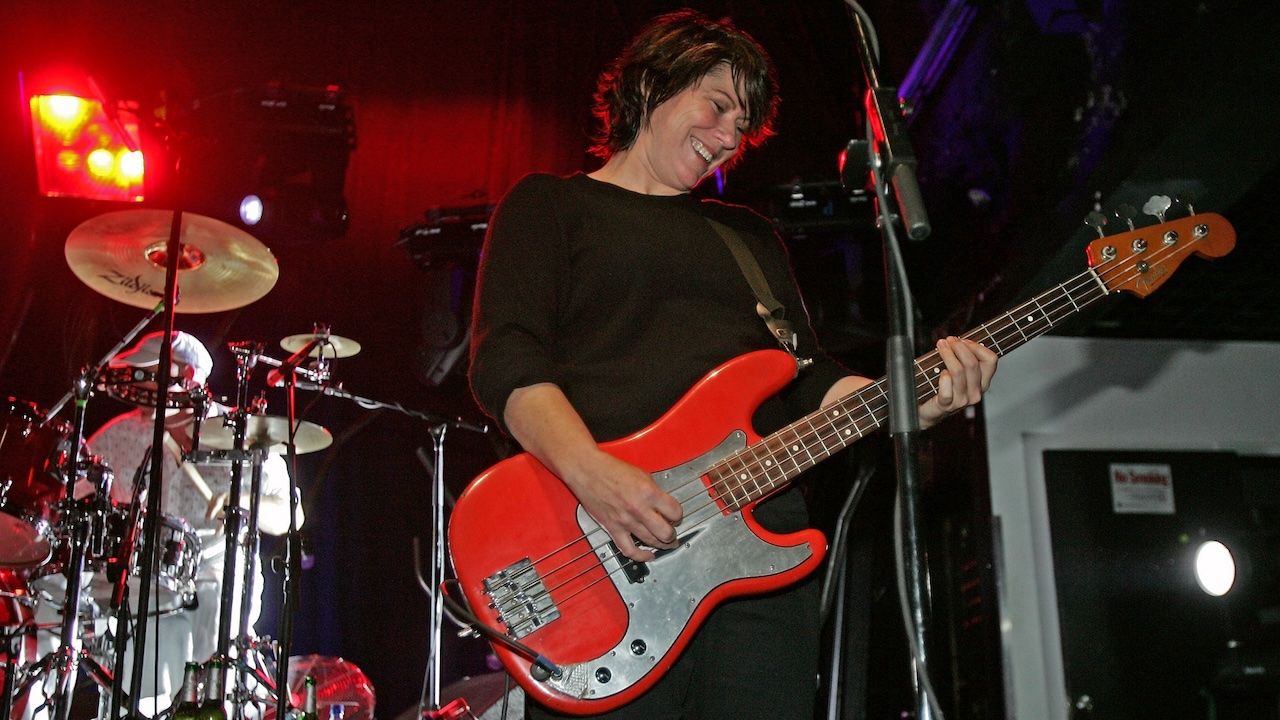
“My primary bass is a Fender Precision,which I plug into an Ampeg SVT. I also have an Ernie Ball Music Man StingRay; I try to switch between them on stage, but there’s rarely time between songs. The Precision is a ’62 reissue.”
“When did you transition from the Aria?”
“While working with producer Gil Norton on Doolittle, he looked at my Aria and said, ‘uh, no.’ So I had to go to Boston and buy a new bass as he refused to record with mine!”
“How did you record back then?”
“Typically, I brought my Peavey Combo 300 and sometimes a Marshall. I thought it was cool to have a Marshall bass amp,but it never sounded great. The first two albums featured the Combo 300 and the Aria bass. I’d use a DI alongside a mic’d combo to capture both a thin and a thick sound.”
“Did you continue using the Precision after Doolittle?”
“No. I switched to a Music Man StingRay for Bossanova because it was active and had a different tone. I was experimenting with bass sounds then. I used the StingRay as my main instrument live, too. I think it was probably because it sounded less country than the Fender.”
“For Trompe le Monde, we were recording a song, and whatever bass I was using was out of tune high up the neck, which bothered Gil, so I went and got a Steinberger.”
“I played it on one track; it was okay because it had this unique, organ-like sound, which I liked, but I felt embarrassed playing it. It’s odd; it has no headstock. I don’t understand why they do that.”
“Any special picks?”
“The green Dunlops with the little turtle logo.”
“How about strings?”
“Whatever anyone puts on. Ideally, they’re old. I can’t stand new strings. I think I have a set of Dean Markley Blue Steels.”
Combining Vocals and Bass
“How do you manage singing while playing bass?”
“It’s a lot different from playing rhythm guitar and singing. I really had to practice. Sence what I sing with the Pixies usually isn’t the lead melody line, it doesn’t always start at the beginning of the four-count, which adds to the challenge.”
“Also, for some reason, all of our guitar parts are somewhat unconventional - perhaps due to our ‘no blues’ rule. So especially live, if we’re on a stage where I can’t hear the band well, the only clear note I have to guide me is Joe’s guitar. So yes, that was challenging live.”
“I’m better live now because I wear one earplug. But it was particularly strange – especially starting Gigantic. Whatever I was singing would work until an actual note was introduced.”