The Stratocaster’s Legacy: Innovations to Tackle Its Most Notorious Flaw
Seventy-one years have passed since the Stratocaster made its debut, initially met with lukewarm enthusiasm. Yet,over the decades,it has ascended to become the most popular guitar in history.
This claim is widely accepted, as many enthusiasts regard it as the epitome of guitar design-“Leo nailed it on the first try!” numerous luthiers outside of Fender have crafted their own interpretations of the Stratocaster, often with only slight modifications.
However,since the early 1970s,a multitude of designers have attempted to enhance this seemingly flawless instrument. Today, the market is flooded with aftermarket components-hardware and pickups-aimed at ‘upgrading’ the Stratocaster more than any other electric guitar.
Identifying the Stratocaster’s flaw
What exactly is the issue with the Stratocaster? Every component, from the string tree to the strap button, has been subject to ‘improvements’ by various makers. The most notable weakness is its single-coil pickups, notorious for picking up unwanted hum that can disrupt performances or recordings.
A common solution is the reverse-wound,reverse-polarity (RWRP) middle pickup,which helps cancel hum in certain pickup combinations.Back in the day, Fender didn’t seem overly concerned about this issue, only introducing a humbucker in the early ’70s, which didn’t quite capture the essence of the “Fender sound.” This quest to eliminate hum has spurred an entire industry of innovators creating hum-cancelling single-coil-sized pickups,utilizing stacked or side-by-side coils,as well as active designs from brands like EMG and Fishman.
Creative Solutions to Noise
Various noise-cancelling techniques have emerged, including the use of copper foil in body cavities and around pickup coils, dummy coils, and systems like the Ilitch backplate hum-cancelling setup. Yet,few,if any,have managed to replicate the classic Strat’s distinctive tone. Living with some hum has become part of the Stratocaster experience.
While Fender has introduced numerous hum-reducing pickups since the ’70s Wide Range humbuckers-such as Lace Sensors and various ‘Noiseless’ models-the company currently employs its hum-cancelling Noiseless Vintage Strat pickups exclusively on the American Ultra II models, with the Noiseless versions on the Mexican-made Player II Modified range.
For instance, the newly launched American Ultra Luxe Vintage models feature modern upgrades, yet they still utilize the traditional Pure Vintage ’61 Strat single coils.
Hum-Free or Not?
In the UK, Tonerider has been developing noise-cancelling pickups for years. designer Andrew Cunningham notes, “I’ve been experimenting with dummy coils and noise-cancelling designs for nearly two decades, but others beat me to it! I started producing non-hum-cancelling pickups, and they sold well. When I asked players about noise, they didn’t seem to concerned.”
“Many rock guitarists opted for humbuckers, but now there’s a middle ground where not everyone wants to go that route. If you can achieve that glassy, bell-like tone with dynamics, why not use hum-cancelling pickups? It simplifies things for your studio or live engineer.Some might miss the hum, but that’s akin to the crackle of vinyl-everyone has their preference.”
Tonerider’s first noise-cancelling Apex Classic single coil set has been in development for several years. Andrew explains, “[We’re] striving for the perfect balance of punch and ‘air’ in the tone, avoiding the annoying midrange honk that many stacked single coils exhibit.” These pickups first appeared on Eastman’s FullerTone models before being offered as aftermarket sets.
In a review of those Eastman guitars, we found that the pickups complemented the DC ’62 model exceptionally well, where two Apex-style units were used in the middle and neck positions alongside a soapbar-sized humbucker at the bridge.
On the single-cut SC ’52, an Apex T-style pickup was installed in the bridge position, which Andrew admitted he preferred over their standard Tele replacement bridge pickup. “Sometimes, you create an enhancement to address a specific issue-like noise-and with the Apex Tele bridge pickup, it enhances playability.”
“There’s a slight compression effect, making it easier to play-you just keep going! Plus, you can crank up the gain and stop the strings, and it’s silent.”
Modern Upgrades for Classic sounds
Utilizing new-design pickups like these on contemporary guitars such as the fullertones makes perfect sense; there’s no direct comparison to a vintage 1962 model.However, offering Apex technology as aftermarket pickups for virtually any Stratocaster presents a challenge: we’re measuring these new humbuckers against 70 years of that iconic single-coil sound, hum included.
Tonerider is marketing the Apex Classic set as “vintage-voiced hum-cancelling pickups for all Stratocasters. Experience the ultimate glassy, bell-like Strat tone, now with studio-level hum reduction.Perfect for blues, funk, country, and more.”
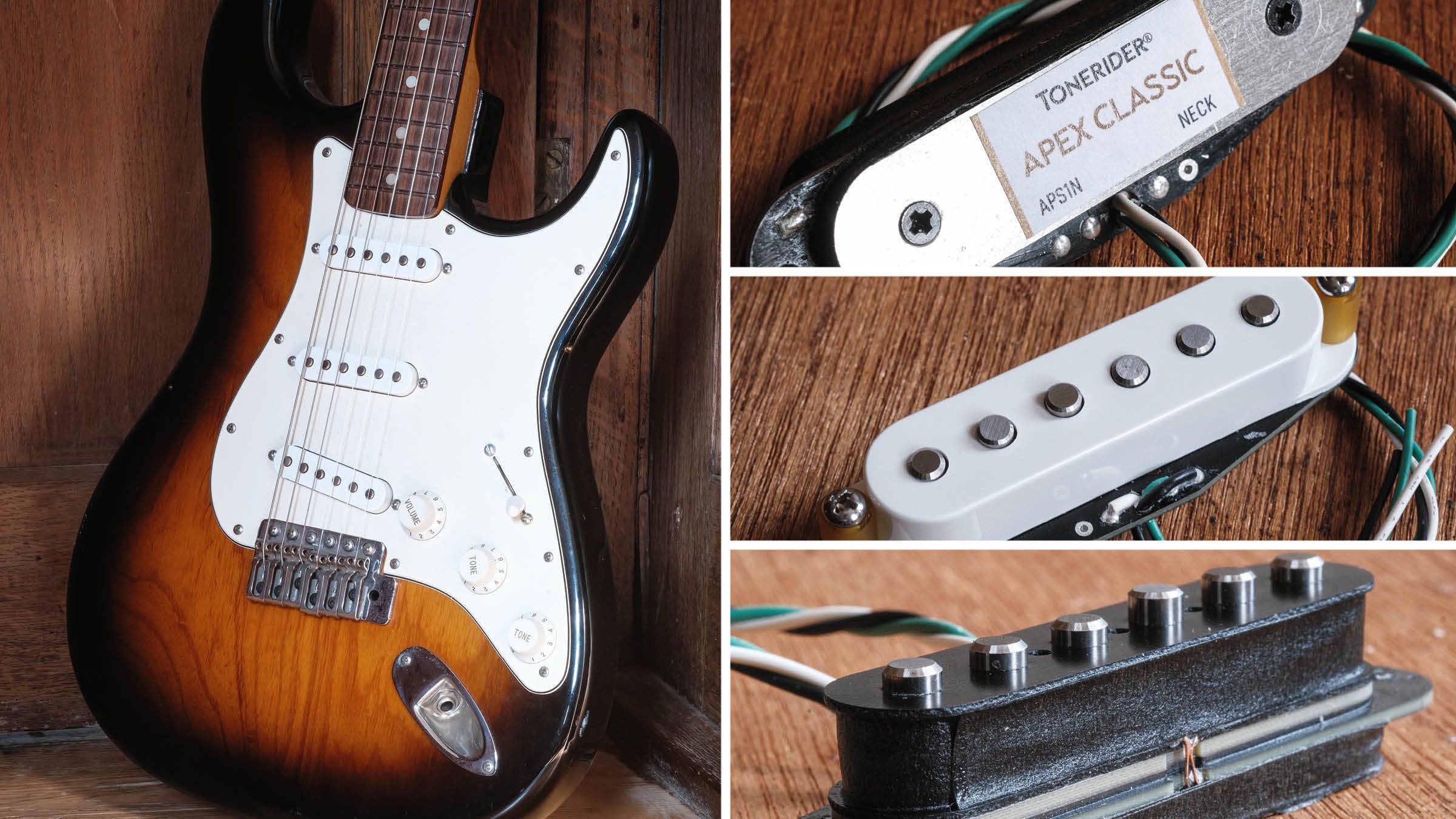
These pickups are well-packaged and meticulously crafted. Although they are a stacked design,their overall depth measures 18.5mm with the cover removed (standard vintage-style Fender pickups are closer to 15mm). They also come with standard-sized covers and are supplied with Tonerider’s pearl white nylon types.
The construction is notable, featuring a top coil approximately 10mm deep, while the lower coil (separated by a hard plastic spacer) is about half that depth, with a steel baseplate indicating the position-specific legend.
The staggered height Alnico V magnetic poles are neatly beveled, with a uniform 5mm diameter. The top three poles (which protrude slightly above the cover) appear to be the same height, with the D string being the tallest, followed by the A and low E strings sloping down.
When installing a complete set, the white or yellow (for the middle pickup) leads connect to the pickup switch inputs, while the green and black wires go to ground.If you mix Toneriders with other brands and encounter a phase issue, simply swap the white or yellow wires with the black ones. Handy to know!
The Apex pickups are designed to work seamlessly with standard stratocaster pot values, eliminating the need for additional modifications. Plus, as they are passive pickups, there’s no battery to worry about.
A Suitable Ride
To test the Apex pickups,I decided to use what I call my ‘modern’ Stratocaster. Interestingly,there’s not a single Fender component on this guitar,which serves as a striking example of the ‘improvements’ many have made to this iconic design.
The neck is from DiMarzio, dating back to the early ’80s when the company was producing necks and bodies alongside pickups. Rumor has it that the wood components were subcontracted to renowned builders like Grover Jackson and stuart Spector.
Irrespective, this neck has been part of various guitars as the early to mid-80s. It’s paired with a swamp ash body from Warmoth, a pioneer in aftermarket bodies and necks, and was assembled by the late luthier Sid Poole, whose signature is visible in the spring cavity.
Original to the build are Sperzel rear-locking tuners, among the first designs to gain popularity. This upgraded vibe continues with Trev Wilkinson’s VSVG vibrato, one of my favorite vintage-inspired designs, even though I currently use the guitar as a hardtail with four springs for added tension.
Now, the pressing question is: does my enhanced modern Stratocaster sound like a vintage instrument from the 1950s?
Subsequent modifications by the team at Charlie Chandler’s Guitar Experience include stainless-steel frets and a Plek setup, along with the Buzz Feiten Tuning System.
in essence, the new Toneriders are in excellent ’upgraded’ company, replacing a set of darker-sounding aftermarket stacked single coils from a well-known brand.
When plugged in, the absence of hum is reminiscent of a traditional humbucker-though not quite the unnerving silence of EMGs-instilling confidence that you won’t encounter issues during a performance. Even with gain and vintage fuzz tones, controlling or muting the guitar is effortless, allowing you to focus on your music.
So, does my modern Stratocaster sound like a vintage piece from the 1950s? It certainly retains the essence of a Stratocaster-and a very good one at that.
Compared to various single-coil Strats (some equipped with high-end pickups), the Apex Classics come impressively close. They seem to benefit from being positioned slightly closer to the strings, which helps narrow the tonal gap.
If you enjoy playing at high volumes with crunchy or heavier gains,the Apex Classics might be just what you need. Rolling back the bridge-pickup tone control brings you into a more vintage territory, while the neck pickup delivers a full, fat sound with percussive clarity.
Some rock enthusiasts might crave a bit more punch, especially at the bridge-perhaps a spicier hot Classic? Tonerider has that covered with the recently launched Apex plus, designed to “deliver midrange muscle while maintaining single-coil clarity.” Apex HSS sets are also set to debut in mid-October.
Much like the Stratocaster itself, if you’re not facing any issues, you may not need to explore modern upgrades. Though, if you’ve struggled with hum-whether at lower or higher gains-these Apex Classics are definitely worth considering, especially given their attractive price point.
Specifications
Product: Tonerider Apex Classic set
Price: £140
Origin: Designed in the UK; manufactured in China
Technical Specs: Single-coil-sized stacked humbuckers, available with left, right, or flat magnet stagger
Magnets: Alnico V
DCR: 7kohms (bridge); 6.3k (middle and neck)
Options: Magnet stagger, white, black, parchment, or cream covers. Individual pickups priced at £50
Skill Level: Easy to install if you can solder!
Contact: Tonerider