What’s This All About?
MIDI guitars have been around for quite some time. From Adrian Belew’s eccentric Parker Fly to the Boss GK-3 pickup,brands have sought to enhance the guitar’s creative potential for decades.
Enter Zivix, the parent company of Jamstik, a fresh player in this arena. their technology has garnered attention for its impressive controllability, with customizable settings being a significant factor in its appeal. Jamstik has now integrated its MIDI guitar technology-transforming the guitar into a MIDI controller-into Strandberg’s innovative, ergonomically crafted guitar.
At its core, this instrument features the Zivix Jamstik MIDI module and a hexaphonic pickup, strategically positioned between the treble pickup and bridge.This setup grants musicians full MIDI capabilities to manipulate synths and VSTs directly from their guitar. This not only eliminates the tedious task of inputting MIDI notes into a DAW but also streamlines the creative process, allowing players to express themselves more intuitively without needing an encyclopedic knowledge of the fretboard.
While the concept of MIDI guitars may seem dated,the technology behind Jamstik is anything but.
“We made significant advancements in our MIDI technology around 2020, and there was some skepticism,” shares Meredith Gaslin, Jamstik/Zivix’s Marketing Director. “In the guitar manufacturing world,people questioned,’Roland has done it. Fishman has done it. What makes yours different?’ Our response was, ‘We’re embedding the processors directly into the guitar. We can actually implement MIDI MPE and have developed new algorithms.’ The technology has evolved; this isn’t a relic from 40 years ago.”
When Jamstik struggled to find a partner willing to incorporate its technology into existing guitars,it took matters into its own hands,creating its own line of electric guitars,including a headless model. Now, though, the Jamstik brand proudly carries the Strandberg name.
“Once we established our presence in the market, demand for our technology in ‘real guitars’ surged,” Gaslin explains. There were inquiries for modification kits, similar to the Boss GK-3, allowing players to integrate the technology into their own instruments, but the process is more complex than it seems.
“We want the pickup to be calibrated and positioned correctly from the factory,” Gaslin emphasizes. “we aim for the processors to be integrated into the guitar to eliminate user error during installation. Our goal is to make it plug-and-play. When we met Strandberg at NAMM a couple of years ago, we thought a collaboration would be exciting, and now it has come to fruition. It’s a perfect blend of our favorite guitar and our technology.”
“The collaboration began with discussions between Ola Strandberg and Jamstik; we both wanted to explore ways to enhance creativity for contemporary guitarists,” states Johan Malin, CMO of Strandberg. “It has truly materialized as we envisioned.From Strandberg’s perspective, our mission is to help musicians unlock their creative potential, and partnering with Jamstik adds an exciting technological dimension.”
The foundation of this collaboration is the Strandberg Boden Essential, the brand’s first electric guitar priced under $1,000. This model simplifies the specifications to make it more accessible while retaining the ergonomic playability that Strandberg is renowned for. This breakthrough allowed Strandberg to finally collaborate with Jamstik.
“We realized that if we integrated our technology into a premium Boden, we would alienate many potential users who would love to access this innovation,” Gaslin explains. The only trade-off is the absence of fanned frets, which could have complicated the design and increased the recalibration costs for the Jamstik pickup.

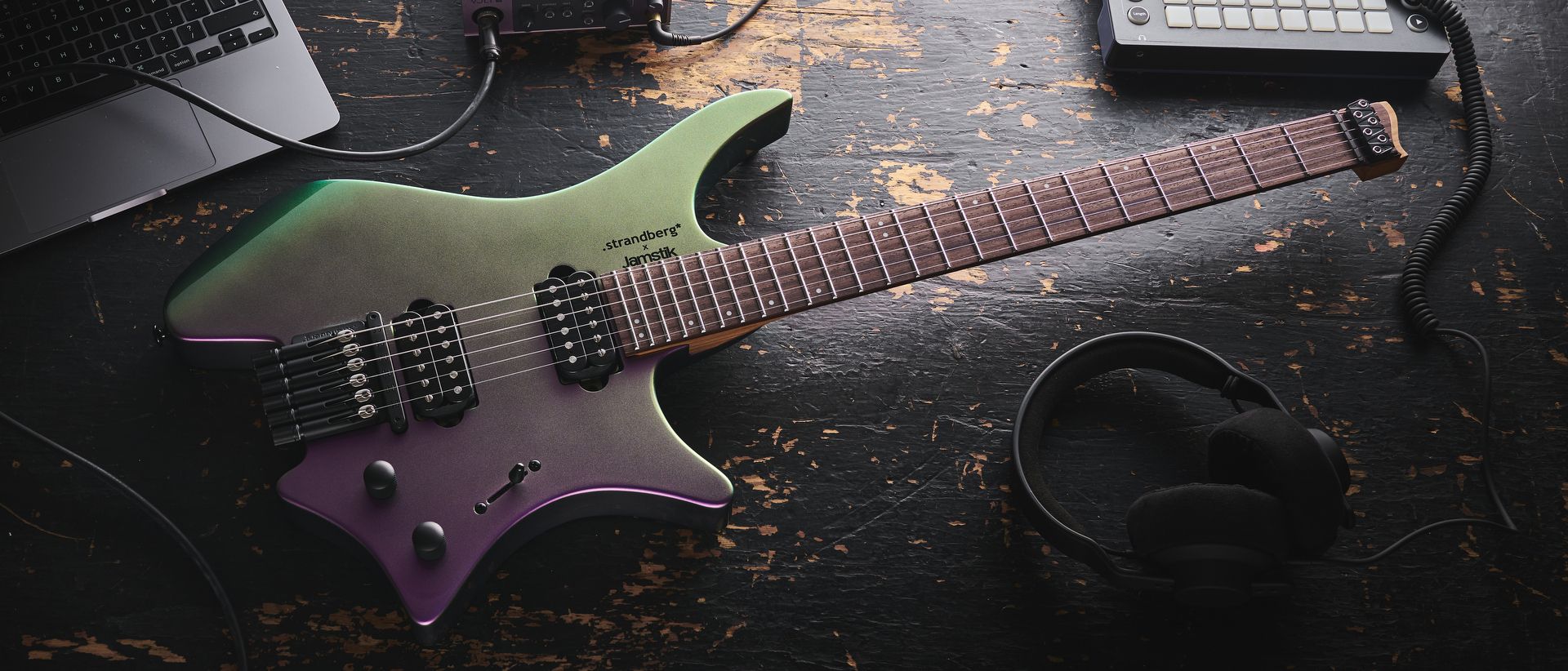
While the unconventional trapezoidal EndurNeck remains, there are some unique specifications, including a meranti body for tonal neutrality, custom Strandberg OEM neck-and-bridge humbuckers, and white plastic inlays.
Specifications

- Price: $2,199/£1,799
- type: Electric MIDI guitar
- BODY: Meranti
- NECK: Roasted maple
- FINGERBOARD: Rosewood
- FRETS: 24
- PICKUPS: Strandberg custom OEM neck and bridge humbuckers
- CONTROLS: 5-Way Pickup Selector, Volume, Tone
- HARDWARE: Zivix Jamstik MIDI module and hexaphonic pickup, Strandberg Arc 6-string Straight Hardtail Bridge and String Locks
- LEFT-HANDED: No
- FINISH: Chameleon Burst
- CASE: Strandberg Essential gig bag
- CONTACT: Strandberg
Construction Quality

Build Quality Rating: ★★★★
Even for those who prefer customary finishes-favoring natural wood grain over flashy bursts and cosmic designs-it’s hard not to be impressed by the finish. It resembles a sci-fi masterpiece; a color-shifting alien spacecraft shaped into what is arguably the most futuristic guitar available today.
Beneath that stunning exterior lies a refined Strandberg Essential,and it plays as smoothly as any other Strandberg model. The neck feels natural in hand, and every contour is designed for comfort rather than mere aesthetics.
The cutaway at the base of a Strandberg is crucial for playing comfort; it allows the player’s leg to fit snugly when playing in a classical position, and this design remains untouched. The control port for the hex pickup, featuring an on/off switch and a USB-C port, is also conveniently located in this area, making it feel like it was always meant to be there.

Though,the backplate is not significantly larger than that of the N2 Boden Standard; the space is utilized intuitively. This isn’t a crude aftermarket modification; it’s a thoughtfully designed and elegantly executed feature.
that said, it doesn’t fit perfectly. ”Some of the intricacies are a bit complex,” Gaslin notes. “As a notable example, the custom-molded backplate is flame-resistant due to the lithium-ion battery housed within. We had to implement modifications like that.”
One concern I had was whether the MIDI pickup, positioned between the bridge pickup and the Arc hardtail bridge, would struggle to track my playing if my hand moved closer to-or even over-the fretboard. Those worries were quickly dispelled; regardless of hand position, the pickup tracked my movements with remarkable accuracy. There’s some impressive science behind this.
“Positioning the hex pickup closer to the bridge enhances MIDI tracking performance because it reduces string displacement and minimizes harmonic overtones in that section of the string,” Gaslin explains. “This results in a cleaner signal for pitch-to-MIDI conversion and decreases bleed between the individual hex pickup channels.”

Functionality

Usability Score: ★★★★☆
The guitar comes with a convenient setup leaflet and essential tools tucked inside its gig bag. By adhering closely to Jamstik’s instructions, you can quickly start making music, but taking the time to adjust the pickup height correctly will yield better results.
The hex pickup should be positioned slightly over 1mm from the strings at its highest point, specifically beneath the third and fourth strings. A handy 1mm guitar pick is included as a gauge, along with two screws on either side of the pickup for height adjustments. it’s a straightforward plug-and-play experiance, and connecting it to my DAW (Reaper, in this case) was as simple as setting up any other MIDI controller.
For optimal connectivity, it’s best to connect the included USB-C cable directly to your computer. However, since not all computers have USB-C ports, an adapter (which you’ll need to purchase separately) can be quite useful. Additionally, it comes with a five-pin MIDI/TRS cable for use with traditional MIDI devices.
During my initial recording tests with the Jamstik, I was able to do something I had never attempted before: record both guitar and MIDI at the same time. The guitar handled this seamlessly. Initially, the MIDI tracking lagged slightly, but adjusting the sensitivity and velocity settings in the Jamstik Creator tool resolved that issue.
I was able to do something I had never attempted before: record both guitar and MIDI at the same time. The guitar handled this seamlessly.
If the sensitivity is set too high, even the slightest brush of my fingers against the strings while shifting frets is detected. Fortunately, the beauty of MIDI is that these nuances can be adjusted in post-production, but taking a moment to fine-tune the settings can simplify the process. Achieving precise tracking is relatively easy.
Adjusting the block/buffer size in Reaper (or any DAW) can also help mitigate latency issues, similar to an overly cautious security guard. However, I did encounter minor tracking inconsistencies, which seemed to depend on the specific plugins used, necessitating ongoing sensitivity adjustments.

SubMission Audio’s Dijn Bass II is extremely sensitive, picking up overtones as notes, and drum plugins (like GGD invasion and Odeholm Audio) exhibit similar behavior. Thus, it’s best to reduce sensitivity.conversely, the BBC’s Symphony Orchestra plugin performs better with higher sensitivity settings.
While playing most instruments on the guitar feels intuitive-tracking basic string lines, choirs, synths, and bass-using the guitar to input drum parts feels quite unusual. Some instruments are simply more suited to being played on a MIDI keyboard. However, this is not a flaw of the Jamstik; having the option to do both is incredibly empowering.
Audio Quality
Audio Quality Score: ★★★★

one of the first things I do when connecting is control the BBC Symphony Orchestra plugin from Spitfire Audio, starting with a piano sound. The output from my speakers resembles a piano tonally, yet it also retains a guitar-like quality. My phrasing and note execution, especially with bends, unmistakably reflect a guitarist’s style, rather than that of a pianist.
In the Jamstik Creator app, there’s an option to disable note bending, allowing me to play as I normally would without the unintended effects.
“A shift in mindset is crucial, depending on the plugin your using,” Gaslin acknowledges. “Having that perspective is beneficial. When you engage with something like a cool synth bass, you want to play it on a stringed instrument, making it feel more intuitive than using a MIDI keyboard. I appreciate that resonance.”
With my perspective adjusted, it’s clear why this guitar can serve as a powerful studio tool, which, several months post-launch, is where Strandberg and Jamstik are witnessing its most significant request.
The guitar is designed to become the driver of whatever plugins I want.
“It primarily functions as a workhorse in the studio,” Gaslin confirms. “Artists have mentioned that thay arrived at a session as guitarists but ended up receiving production credits because they could play synth parts,leaving others astonished.”
Thus, the guitar is engineered to be the driving force behind any plugins I choose, but Gaslin emphasizes the sounds within the Jamstik Creator tool-available as standalone software and a VST3 plugin within a DAW-for a significant reason.
“The app was initially intended for settings, but we had an engineer who suggested adding sound design features,” she explains. “We ensured that all sounds were meticulously crafted for the guitar format, as many VSTs and plugins are frequently enough designed with keyboards in mind.”
From my experience, she makes a valid point.Some plugins have limitations on the notes they can produce, but the Jamstik sounds do not have such octave restrictions; while not all sounds appealed to me, some-like the baritone synth, ambient piano, and Magical Arp-were genuinely impressive and sparked my creativity. Others, admittedly, were amusing but not especially useful. Though, I don’t view this as a dealbreaker; these features are simply added bonuses.
The guitar’s potential is as vast as the plugins I utilize and the ideas I can conceive. It truly acts as a catalyst for creativity, streamlining my writing process and eliminating the tedious point-and-click tasks. Especially since I can connect the jack to my interface to record both guitar and MIDI together, using different sounds for each.
This kind of quirk feels like it was plucked gleefully from that sci-fi world. It’s incredible.
I recall watching Back to the Future as a child, excited about the possibility of riding a hoverboard. While that hasn’t come to fruition, this kind of innovation feels like it was joyfully extracted from a sci-fi universe. It’s remarkable.
That said, it can only comfortably be tuned down to C standard-something the manual cautions against-so it does have its limitations.Though, the transpose and octave +/- feature provides a reasonable workaround.
Importantly,aside from the MIDI pickup,this remains a fully functional electric guitar. It features the same Strandberg 6-string Humbuckers, including a hot bridge and Vintage model in the neck. For someone who typically prefers to mod guitars with their own brand of pickups, I find these to be quite impressive.

These pickups handle high-gain settings well, provided noise gates are used to eliminate any unwanted noise. They excel in both crunch and clean tones. While they may not perform well with extremely low tunings, they are more than capable for genres like rock, jazz, soul, blues, pop, and even some lighter metal.The only downside is the absence of a coil-split feature, which is typically reserved for higher-end models.
This guitar could easily be dismissed as a gimmick, but it is indeed far more than that. As a guitar, it is indeed exceptional; as a MIDI controller, it is remarkable. While not without its flaws, it stands as a leader in its market.

Conclusion

It’s crucial to understand that while the guitar is marketed as plug-and-play, some minor adjustments are necessary upon unpacking to suit your playing style. However, these tweaks significantly enhance the overall playing experience.
The primary challenges I encountered with the guitar, particularly regarding MIDI tracking, stemmed from the limitations of the plugins I used. The price point may raise eyebrows,but this is a premium combination: one of the finest electric guitars available (even if this is its most budget-amiable model) paired with one of the most elegant MIDI pickups on the market.
The cost is justified. I don’t feel the price is excessive when I’m exploring a realm of sounds I’ve never experienced from a simple wooden instrument with six strings.
As Gaslin mentioned, I don’t envision taking this to live performances frequently-but it would certainly be capable. It excels in the studio, becoming central to my creative workflow. The guitar performs exceptionally well on its own, and despite a few minor issues, the MIDI functionality is an absolute pleasure.
Final Verdict: MIDI guitars have been part of the music landscape for years, but this, to paraphrase a famous phrase, feels like a small step for guitars and a giant leap for creativity. In an era where AI threatens to diminish the joy of music creation,could this be the sci-fi-inspired tool to combat that? It just might be.
Usability Score: ★★★★☆
The guitar arrives with a useful setup guide and essential tools tucked inside its gig bag.By closely following Jamstik’s instructions,you can quickly start making music,but taking the time to adjust the pickup height correctly will yield better results.
The hex pickup should be positioned slightly over 1mm from the strings at its highest point, specifically beneath the third and fourth strings. A handy 1mm guitar pick is included as a gauge, along with two screws on either side of the pickup for height adjustments. it’s a straightforward plug-and-play experience, and connecting it to my DAW (Reaper, in this case) was as simple as setting up any other MIDI controller.
For optimal connectivity, it’s best to connect the included USB-C cable directly to your computer. However, since not all computers have USB-C ports, an adapter (which you’ll need to purchase separately) can be quite useful. Additionally, it comes with a five-pin MIDI/TRS cable for use with traditional MIDI devices.
During my initial recording tests with the Jamstik, I was able to do something I had never attempted before: record both guitar and MIDI at the same time. The guitar handled this seamlessly. initially, the MIDI tracking lagged slightly, but adjusting the sensitivity and velocity settings in the Jamstik Creator tool resolved that issue.
I was able to do something I had never attempted before: record both guitar and MIDI at the same time. The guitar handled this seamlessly.
If the sensitivity is set too high,even the slightest brush of my fingers against the strings while shifting frets is detected. Fortunately, the beauty of MIDI is that these nuances can be adjusted in post-production, but taking a moment to fine-tune the settings can simplify the process. Achieving precise tracking is relatively easy.
Adjusting the block/buffer size in Reaper (or any DAW) can also help mitigate latency issues, similar to an overly cautious security guard. Though, I did encounter minor tracking inconsistencies, which seemed to depend on the specific plugins used, necessitating ongoing sensitivity adjustments.
SubMission Audio’s Dijn Bass II is extremely sensitive, picking up overtones as notes, and drum plugins (like GGD Invasion and Odeholm Audio) exhibit similar behavior.Therefore, it’s best to reduce sensitivity. On the other hand, the BBC’s Symphony Orchestra plugin performs better with higher sensitivity settings.
While playing most instruments on the guitar feels intuitive-tracking basic string lines, choirs, synths, and bass-using the guitar to input drum parts feels quite unusual. Some instruments are simply more suited to being played on a MIDI keyboard. However, this is not a flaw of the Jamstik; having the option to do both is incredibly empowering.
Audio Quality
Audio Quality Score: ★★★★
One of the first things I do when connecting is control the BBC Symphony Orchestra plugin from Spitfire Audio, starting with a piano sound. The output from my speakers resembles a piano tonally, yet it also retains a guitar-like quality.My phrasing and note execution, especially with bends, unmistakably reflect a guitarist’s style, rather than that of a pianist.
In the Jamstik Creator app,there’s an option to disable note bending,allowing me to play as I normally would without the unintended effects.
“A shift in mindset is crucial, depending on the plugin you’re using,” Gaslin acknowledges. “Having that perspective is beneficial. When you engage with something like a cool synth bass, you want to play it on a stringed instrument, making it feel more intuitive than using a MIDI keyboard. I appreciate that resonance.”
With my perspective adjusted, it’s clear why this guitar can serve as a powerful studio tool, which, several months post-launch, is where Strandberg and Jamstik are witnessing its most significant application.
The guitar is designed to become the driver of whatever plugins I want.
“It primarily functions as a workhorse in the studio,” Gaslin confirms. “Artists have mentioned that they arrived at a session as guitarists but ended up receiving production credits because they could play synth parts, leaving others astonished.”
Thus, the guitar is engineered to be the driving force behind any plugins I choose, but Gaslin emphasizes the sounds within the Jamstik Creator tool-available as standalone software and a VST3 plugin within a DAW-for a significant reason.
“The app was initially intended for settings, but we had an engineer who suggested adding sound design features,” she explains. “We ensured that all sounds were meticulously crafted for the guitar format, as many vsts and plugins are frequently enough designed with keyboards in mind.”
From my experience, she makes a valid point. Some plugins have limitations on the notes they can produce, but the Jamstik sounds do not have such octave restrictions; while not all sounds appealed to me, some-like the baritone synth, ambient piano, and Magical Arp-were genuinely impressive and sparked my creativity. Others, admittedly, were amusing but not particularly useful. Though, I don’t view this as a dealbreaker; these features are simply added bonuses.
The guitar’s potential is as vast as the plugins I utilize and the ideas I can conceive. It truly acts as a catalyst for creativity, streamlining my writing process and eliminating the tedious point-and-click tasks. Especially since I can connect the jack to my interface to record both guitar and MIDI simultaneously, using different sounds for each.
This kind of quirk feels like it was plucked gleefully from that sci-fi world. It’s incredible.
I recall watching Back to the Future as a child,excited about the possibility of riding a hoverboard. While that hasn’t come to fruition, this kind of innovation feels like it was joyfully extracted from a sci-fi universe. It’s remarkable.
That said, it can only comfortably be tuned down to C standard-something the manual cautions against-so it does have its limitations. However, the transpose and octave +/- feature provides a reasonable workaround.
Importantly, aside from the MIDI pickup, this remains a fully functional electric guitar. It features the same Strandberg 6-string Humbuckers, including a Hot bridge and Vintage model in the neck.For someone who typically prefers to mod guitars with their own brand of pickups, I find these to be quite impressive.
These pickups handle high-gain settings well, provided noise gates are used to eliminate any unwanted noise. They excel in both crunch and clean tones. While they may not perform well with extremely low tunings, they are more than capable for genres like rock, jazz, soul, blues, pop, and even some lighter metal. The only downside is the absence of a coil-split feature, which is typically reserved for higher-end models.
This guitar could easily be dismissed as a gimmick, but it is far more than that. As a guitar, it is exceptional; as a MIDI controller, it is remarkable. While not without its flaws, it stands as a leader in its market.
Conclusion
It’s crucial to understand that while the guitar is marketed as plug-and-play,some minor adjustments are necessary upon unpacking to suit your playing style. Though, these tweaks significantly enhance the overall playing experience.
The primary challenges I encountered with the guitar, particularly regarding MIDI tracking, stemmed from the limitations of the plugins I used. The price point may raise eyebrows, but this is a premium combination: one of the finest electric guitars available (even if this is its most budget-friendly model) paired with one of the most sophisticated MIDI pickups on the market.
The cost is justified. I don’t feel the price is excessive when I’m exploring a realm of sounds I’ve never experienced from a simple wooden instrument with six strings.
As Gaslin mentioned, I don’t envision taking this to live performances frequently-but it would certainly be capable. It excels in the studio, becoming central to my creative workflow. The guitar performs exceptionally well on its own, and despite a few minor issues, the MIDI functionality is an absolute pleasure.
Final Verdict: MIDI guitars have been part of the music landscape for years, but this, to paraphrase a famous phrase, feels like a small step for guitars and a giant leap for creativity. In an era where AI threatens to diminish the joy of music creation,could this be the sci-fi-inspired tool to combat that? it just might be.
Unleashing Creativity: A Deep Dive into the Strandberg x Jamstik Chameleon Collaboration!
Overview of the Collaboration
the partnership between Strandberg and Jamstik has resulted in the Chameleon MIDI guitar, a groundbreaking instrument that merges traditional guitar playability with advanced MIDI technology. This collaboration aims to empower musicians by expanding their creative possibilities, allowing them to control synthesizers and virtual instruments directly from their guitar.
Key Features of the strandberg x Jamstik Chameleon
- MIDI Integration: The Chameleon features a built-in MIDI module that allows for seamless integration with digital audio workstations (DAWs) and MIDI-compatible software.
- Ergonomic Design: StrandbergS signature ergonomic body shape ensures comfort during extended play sessions, reducing fatigue and enhancing playability.
- Customizable Settings: Musicians can tweak various parameters, including sensitivity and velocity, to tailor the guitar’s response to their playing style.
- high-Quality Pickups: Equipped with Strandberg’s custom humbuckers, the Chameleon delivers rich, dynamic tones suitable for various genres.
Benefits of the Chameleon MIDI Guitar
The Strandberg x Jamstik Chameleon offers numerous advantages for musicians looking to enhance their creative workflow:
- Enhanced Creativity: The ability to control MIDI instruments directly from the guitar opens up new avenues for songwriting and composition.
- Streamlined Workflow: Musicians can record guitar and MIDI concurrently, eliminating the need for tedious MIDI programming.
- Versatility: The Chameleon is suitable for various musical styles,from rock to electronic,making it a valuable addition to any musician’s toolkit.
- Portability: Its lightweight design and included gig bag make it easy to transport, perfect for musicians on the go.
Practical Tips for Using the Chameleon
To get the most out of your Strandberg x Jamstik Chameleon, consider the following tips:
- Adjust Pickup Height: Ensure the hex pickup is set to the optimal height (just over 1mm from the strings) for accurate MIDI tracking.
- Fine-tune Settings: use the Jamstik Creator app to adjust sensitivity and velocity settings to match your playing style.
- Experiment with Plugins: Explore various VSTs and plugins to find the sounds that inspire you the most.
- Utilize MIDI Capabilities: Take advantage of the guitar’s MIDI functionality to control synths and other virtual instruments in your DAW.
Case Studies: Real-World Applications
Musicians across genres have embraced the Chameleon for its innovative features. Here are a few examples:
1.Rock Guitarist: Adam Rafowitz
Adam, a member of the progressive rock band Arch Echo, utilizes the Chameleon to layer guitar tracks with MIDI synths, creating a rich soundscape in his recordings. He appreciates the guitar’s ability to seamlessly integrate with his existing setup.
2. Electronic Music Producer: Sarah Lee
Sarah uses the Chameleon to control various virtual instruments during live performances. The MIDI capabilities allow her to switch between sounds effortlessly, enhancing her live shows and keeping the audience engaged.
First-Hand Experiance with the Chameleon
As a musician who has had the chance to test the Strandberg x Jamstik Chameleon, I found the experience to be transformative. The guitar’s ergonomic design made it comfortable to play for extended periods, and the MIDI integration was intuitive. Recording both guitar and MIDI simultaneously was a game-changer, allowing me to capture my ideas quickly without the hassle of traditional MIDI input methods.
Comparison Table: Strandberg x Jamstik Chameleon vs. Traditional MIDI Controllers
| Feature | Strandberg x Jamstik Chameleon | traditional MIDI Controller |
|---|---|---|
| MIDI Integration | Built-in MIDI module | requires external MIDI interface |
| Playability | Guitar-like feel | Keyboard-based |
| Portability | Lightweight and gig bag included | Varies by model |
| Customization | adjustable sensitivity and velocity | Limited customization options |
Join the Beatbounty Community
Ready to unleash your creativity with the Strandberg x Jamstik Chameleon? Join the Beatbounty platform today! Create an account and submit your ad to connect with other musicians and explore new opportunities.
Become a valued member of Beatbounty platform.
Start selling and connect with fellow musicians – LOGIN or REGISTER!