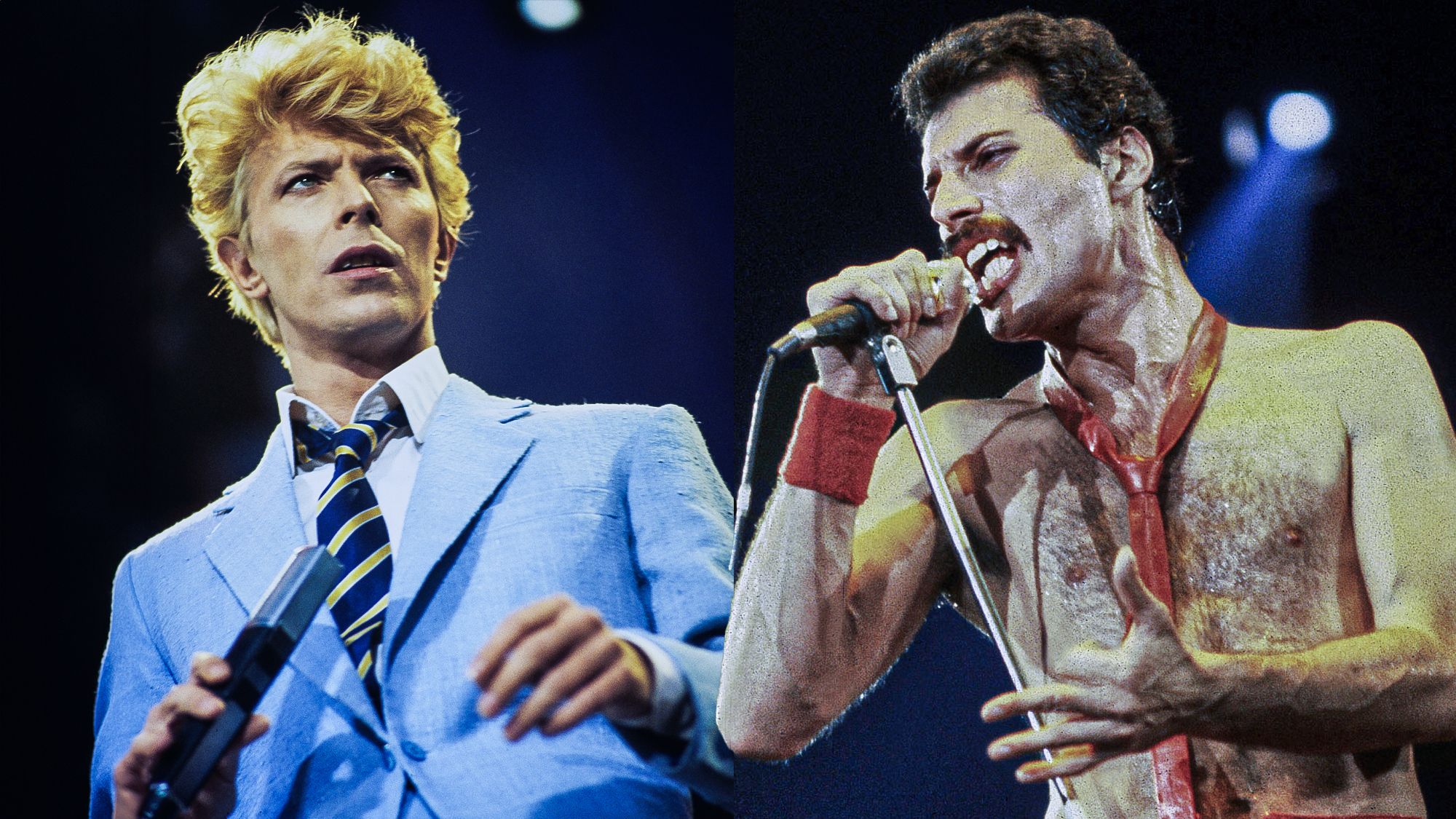
The Unforgettable Fusion: When Queen Joined Forces with David Bowie for ‘Under Pressure’
David Bowie was known for his penchant for unexpected collaborations. Throughout his illustrious career, he lent his voice to a diverse array of artists, from John Lennon and Tina turner to Mick Jagger and even the legendary Bing Crosby. Though, none of these partnerships matched the creative synergy found in “Under Pressure,” the iconic 1981 track that united Bowie with Freddie mercury and Queen. This collaboration not only showcased two of rock’s most remarkable vocal talents but also produced one of the genre’s most memorable bass lines.
A Shared History: the Early Encounters of Bowie and Mercury
Before they became global icons, Bowie and mercury had crossed paths on several occasions. Their first meeting took place in 1969 at Ealing Art College, where Bowie performed a lunchtime gig. At that time, Mercury, then known as Freddie Bulsara, helped Bowie set up a makeshift stage by arranging tables. Two years later, as Bowie was gaining fame with his album Hunky Dory, they met again at Kensington Market in London, where Mercury was working at a clothing stall and attempted to sell Bowie a pair of flamboyant platform boots.
The Perfect Timing: A Meeting of Legends
By 1981, both artists had established themselves in the music industry. Bowie was enjoying the success of Scary Monsters (and Super Creeps), his first number-one album in the U.K. as Diamond Dogs, which featured the hit single “Ashes to Ashes.” Meanwhile, Queen had just scored one of their biggest hits in the U.S. with ”Another one Bites the Dust,” which topped the charts.
“We were jamming to some of his songs and some of ours. we had a few bottles of wine and things.”
The two artists reunited at Mountain Studios in Montreux, Switzerland, where Queen was working on their album Hot Space. Bowie was in the area to record “Cat People (Putting Out Fire)” for the film of the same name. Intrigued by Queen’s progress, Bowie dropped by the studio and contributed backing vocals to their track “Cool Cat,” even though he later opted not to include them in the final cut.
“Bowie kept popping into the studio,” Mercury recalled in 1985. “And we were jamming to some of his songs and some of ours. We had a few bottles of wine and things.” However, those “things” also included a significant amount of cocaine, as noted by co-producer Reinhold Mack. “There was so much blow, but I needed a clear mind,” he shared with Mojo. The artists jammed on various tracks, including Mott the Hoople’s “All the way From Memphis” and “All the Young Dudes,” the latter penned by Bowie, along with Cream’s ”I Feel Free” and “N.S.U.”
Creating ‘Under Pressure’: A Collaborative Journey
eventually, Bowie proposed that instead of covering other artists’ songs, they should create something original. Queen had an unfinished piece titled “Feel Like,” which served as the foundation for “Under Pressure.” Bowie quickly took charge of the session, a challenging feat given the strong personalities of Mercury, Brian May, Roger Taylor, and John Deacon.
“Freddie and David locked horns, without a doubt,” May recounted in a 2017 interview with Mojo. ”But that’s when the sparks fly, and that’s why it turned out great.” Taylor added, “We were all very pig-headed, but Bowie was probably as pig-headed as the four of us put together.”
“He was quite a little dictator in a way when he got going.Brian took offense to it because he didn’t like being told what to do.”
Deacon’s viewpoint on Bowie’s assertiveness was more critical. “He was quite a little dictator in a way when he got going,” he said. “He was pushing us and being dominant, you know. I didn’t mind, but Brian took offense to it as he didn’t like being told what to do.”
Initially, May contributed a heavier guitar sound to the track, giving it a more rock-oriented feel. “It sounded like the Who,” he recalled. “I remember saying to David, ’Oh, it sounds like the Who, doesn’t it?’ He replied, ‘Yeah, well it’s not going to sound like the who by the time I’ve finished with it!’”
Frustrated with the direction of the session, May left early, resulting in much of his guitar work being omitted from the final mix. The prominent riff he had played on electric guitar was replaced with acoustic guitar parts that had been recorded during the demo phase.
Recording Sessions: A Tale of Two cities
While some attendees claim the song was recorded in its entirety during that initial session, others remember a subsequent vocal session between Mercury and Bowie that took place a couple of weeks later in New York City at the Power Station. Jon Bon Jovi, who was an assistant at the studio owned by his cousin Tony Bongiovi, recalled witnessing the two legends recording “Under Pressure.”
“It was literally the biggest recording studio in the world at the time,” he shared during a 2024 appearance on The Late Show. ”One day, I looked through the control room door, and I watched David Bowie and freddie Mercury sing ‘Under Pressure.’ I saw them sing that vocal.”
This account is corroborated by Peter Freestone, Mercury’s personal assistant, in his 2001 memoir, An Intimate Memoir. He noted that the first session lasted twenty-four hours, while the second session in New York extended for another eighteen hours.
Despite the extensive time spent on the track,May noted that there was uncertainty about how to proceed with the song.”There were continual disagreements about how ‘Under Pressure’ should be put out or if it should even be put out at all,” he explained.
A Timeless Classic: The Release and Legacy of ‘Under Pressure’
Ultimately, Queen and bowie decided to release “Under Pressure” as a single in October 1981.The result was Queen’s first U.K. chart-topper since “Bohemian rhapsody” and Bowie’s first since “Ashes to Ashes.” In the U.S.,the song reached a respectable number 29 and has remained a staple on radio playlists ever since.
Following Bowie’s passing in 2016, which came 25 years after Mercury’s death, “Under Pressure” transformed into a tribute to a bygone era of rock legends. The song experienced a resurgence, re-entering charts worldwide and peaking at number five on the Hot Rock & option Songs chart.
even Brian May’s perspective on “Under Pressure” has evolved over time. What once represented the tension of its challenging creation has come to symbolize the remarkable chemistry between Queen and Bowie,encapsulated in a recording that has outlasted them all. “looking back now, I think it’s a very special, significant song for us,” he reflected. “But I would love to sit down quietly on my own and remix it.”