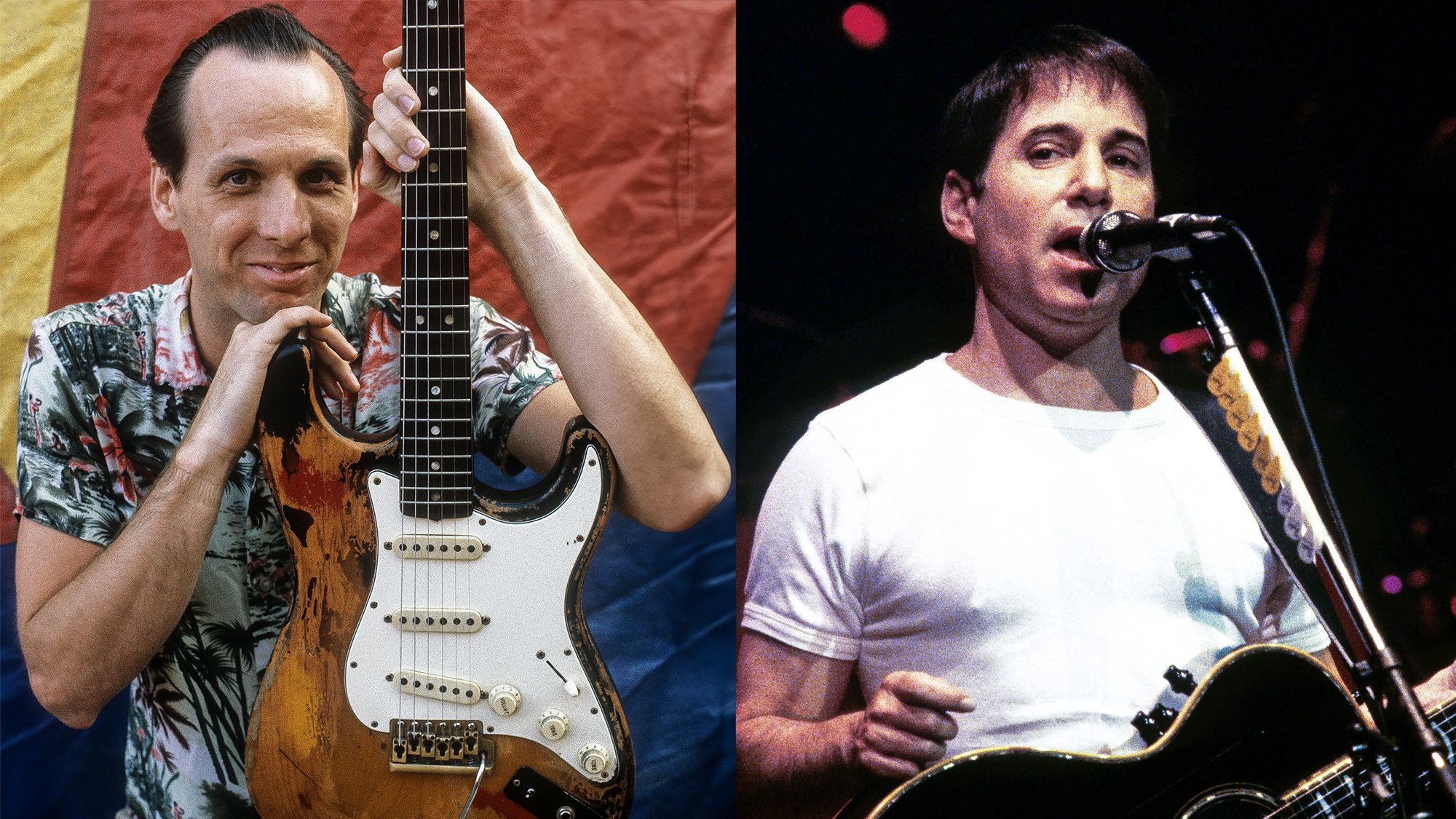
Adrian Belew took a particular approach to his voluminous body of work for others, outside of his membership in King Crimson and the Bears and his solo albums.
“I was always confident I’ll find something that’s unique to me and that will work for their music,” Belew — whose résumé includes David Bowie, Talking Heads, Nine Inch Nails and many more — tells us via Zoom from his home in north-central Tennessee. “That’s what it’s all about for me. They don’t ask me to come in and play like somebody else. They don’t give me instructions very much. They just let me go and I’ll give them a few different choices and then go in and do them.”
The exception to that rule? Paul Simon. Belew was the first non-African musician to play on Simon’s celebrated Graceland album, which turned 40 this month. He created parts on his Roland GR700 guitar synthesizer for “The Boy in the Bubble,” “Crazy Love, Vol. II” and the horn riff for “You Can Call Me Al,” as well as straight guitar on “Under African Skies.”
“Paul Simon was one person who had everything very specific,” Belew says. “‘I want you to play this’ [sings the “You Can Call Me Al” riff], and then I would play it and he’d say, ‘Okay, now try it with a little bit of tremolo on there … No, not that. Try it this way’
“He usually had something very specific in mind, so it was working with him to get that.”
The beginning of ‘You Can Call Me Al,’ originally the horn section was me; I had built, like, four different types of saxophone sounds.”
— Adrian Belew
The culture-blending Graceland, in fact, was as much of a surprise for Belew as it was for Simon’s listeners. The electric guitar virtuoso was two albums into his solo career when he got the call to come to the Record Plant in New York to work on Simon’s new album.
“I was booked in there by myself, with Paul and Roy [Halee], his engineer,” Belew recalls. “I came in a little early, and Roy was playing some music in the studio control room. It was African music. I thought, Wow, this is confusing; maybe he’ll switch to the Paul stuff in a minute.
“So I went in and listened for a while, and then Paul arrived and he said, ‘Let’s get some coffee out here, just kinda get to know each other.’
“And I said, ‘Oh, I just was hearing that music; I guess Roy had the wrong tape up’ — I made a joke. Paul said, ‘How so?’ I said, ‘That’s not your music, right?’ He said, ‘Oh yeah, it is.’ I said, ‘Well, okay. I don’t really get that,’ and he said, ‘Well, great, come into the control room and I’ll play you some stuff. I have words for all this stuff, some words, so I’ll sing them to you, the words that I do have.’”

Watch On
The first song, Belew remembers, was “The Boy in the Bubble,” which opens the album. “He stood next to me, his mouth pretty close to my ear, and he sang these parts. That gave me absolute chills — I mean, Paul Simon singing quietly in your ear like that? Come on. And then, of course, I understood: ‘My God, this guy has completely revisited his career and done something entirely different to it. And genius.’”
The rest of the process was largely trial and error as Belew, Simon and Halee worked on the other songs.
He would always say, ‘Can I see that guitar?’ And then he sat there and sat there and played the sound for 10 minutes.”
— Adrian Belew
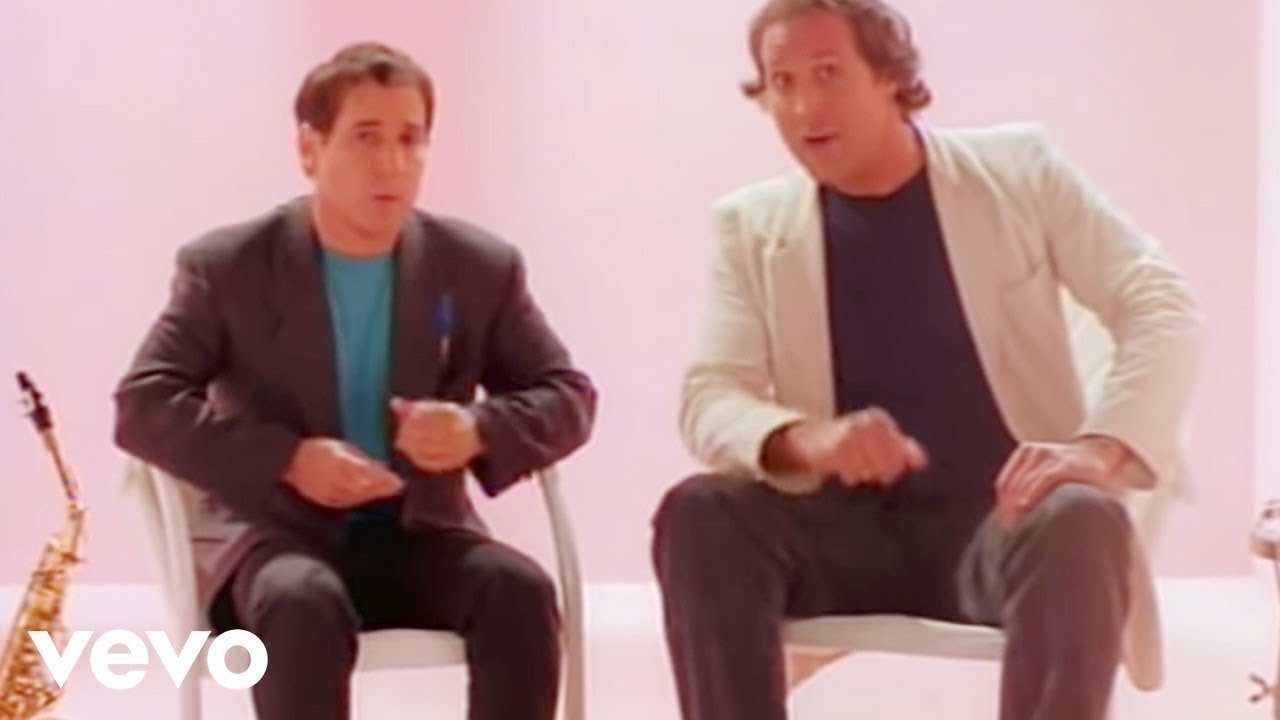
“Every day I was just searching for sounds,” Belew says. “I had all these programs; I would basically say, ‘Okay, lemme think about this,’ and then go play something with that sound. Then I’d try another one. That was the process. The beginning of ‘You Can Call Me Al,’ originally the horn section was me; I had built, like, four different types of saxophone sounds.
“It was a lengthy process, just deciding which of my sounds he wanted in his music. And invariably he would always say, ‘Can I see that guitar?’” Belew laughs. “And then he sat there and sat there and played the sound for 10 minutes.”
Watch On
Belew is justifiably proud to have been part of Graceland, which was top five on the Billboard 200 chart and certified five-times Platinum. Critically acclaimed — albeit criticized by some for violating a United Nations–mandated cultural boycott of still-apartheid South Africa — Graceland won the Grammy Award for Album of the Year in 1987 and in 2006 was added to the Library of Congress’ National Recording Registry.
Even better? “He was the first person who ever sent me a Gold record, even though I’d been on many Gold records again,” says Belew, who also played on Cyndi Lauper’s True Colors album the same year and on Simon’s follow-up, The Rhythm of the Saints, in 1990. “I’ll always love him for that. He’s a great guy.”

These days, Belew is busy with Beat, joining King Crimson bandmate Tony Levin and guitarist Steve Vai in recreating the Crimson catalog of the early ’80s. (Tool’s Danny Carey played drums through the group’s recent tour of Europe; Terry Bozzio will take his place for a North American tour that begins October 9 in Santa Cruz, California.) With Robert Fripp’s blessing — and periodic assistance — the troupe has been a hit with fans and released a live album last year, and Belew says the continued demand is surprising, but only to a degree.
The real surprise is that this music is really as timeless as I thought it was, and it’s being enjoyed by all age groups now — not just old guys.”
— Adrian Belew
“I knew from all my years on Facebook and things there was sort of a pent-up need for this music, and the last King Crimson didn’t play any of it, so I wanted to bring the music back and give it its day,” explains Belew, who’s planning to focus on his solo work next year.
“The real surprise is that this music is really as timeless as I thought it was, and it’s being enjoyed by all age groups now — not just old guys. There’s never been anything like it, before or since, in terms of the compositions and the way the band played together, with lots of different, odd time signatures and so many things going on at once. And yet part of the body of it was singable melodies and things you could relate to. It wasn’t just all outside, heavy instrumentals.”
Belew promises that Beat will be expanding its repertoire during the new dates, too.
“We’re adding in some of the double-trio music from the ’90s, maybe another surprise or two,” he says. “I figure that having four or five different pieces, taking out some of the others and also having a completely different drummer approach … the object for me is to make sure the show is different enough that even if you’ve seen it before you’ll walk out going, ‘I’m glad I saw it again.’ That’s the goal.”