This interview appeared in Guitar Player’s August 1976 issue.
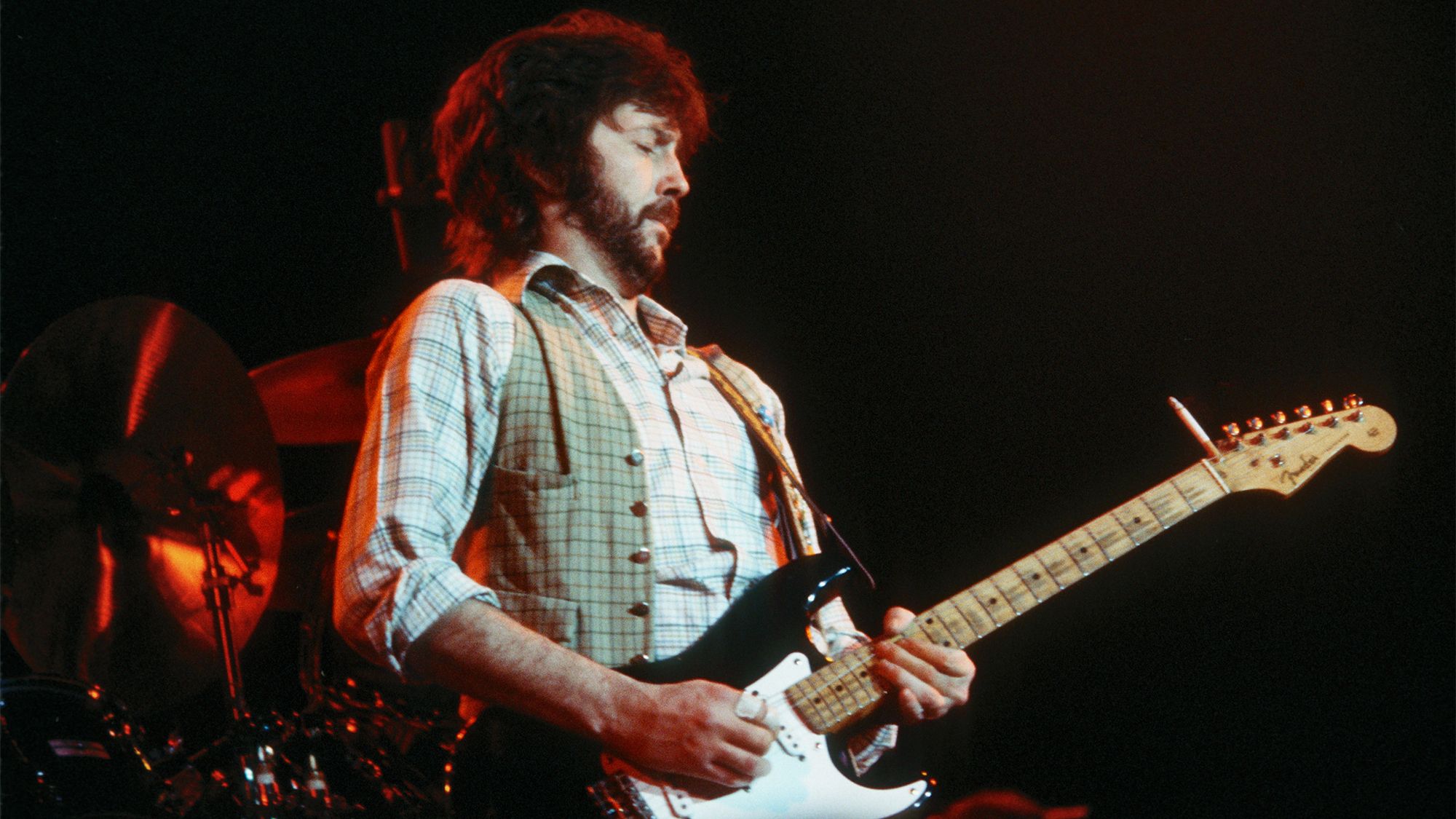
Eric Clapton is now 31 years old. For more than a decade he has been *the* rock guitarist.
Doubtless there are “better known” guitarists such as George Harrison and rock’s “creative genius” on the instrument remains the late Jimi Hendrix, but it would be hard to find anyone to match Clapton’s longevity and consistency as a lead guitarist in the rock field.
When Hendrix’s future manager, Chas Chandler, first approached Jimi with the idea of moving to England, one of the young guitarist’s first questions was, “Will I get to meet Eric Clapton?”
In past Guitar Player readers’ polls, Eric has always placed high, winning Best Rock Guitarist four consecutive years, from 1971 to 1974, then taking a surprise first place in the blues category as a write-in candidate last year. He was also voted Overall Best Guitarist in 1973.
Beginning guitar at around age seventeen, Clapton — born March 30, 1945, in Ripley, England — was a charter member of The Yardbirds, a band whose influence is still strongly felt by many hard rock units. Here his gutsy, aggressive, improvised blues licks established Clapton as one of the first noticeable lead guitarists of that era. Like the American blues bands they emulated, The Yardbirds put the guitar leads and fills into the forefront of their overall sound.
Their first recording, Five Live Yardbirds, was released in England in 1964 when Slowhand, as he was once known, was nineteen years old. Just as the group was beginning to realize a degree of international pop notoriety, Eric quit to concentrate on the blues to be replaced on lead guitar by Jeff Beck and later Jimmy Page. Though For Your Love, the Yardbirds’ first LP released in the U.S., pictured only Beck on the cover, it was in fact Clapton’s guitar which highlighted eight of the album’s eleven tracks.

Already heavily into country blues artists like Big Bill Broonzy, Blind Boy Fuller and Robert Johnson, Clapton then joined John Mayall’s Bluesbreakers and totally immersed himself in Chicago blues. It was during this period that the name Eric Clapton took on a somewhat mythical, cult-figure status in Britain. Like the “Bird Lives” syndrome that swept through bebop havens after the death of Charlie “Yardbird” Parker, the slogan “Clapton is God” could be found scrawled on signposts, sides of buildings and even rocks across England’s countryside.
Within days after leaving the Bluesbreakers, Cream was formed. Consisting of three virtuoso soloists — drummer Ginger Baker, bassist Jack Bruce and “E.C.” on guitar — Cream was perhaps the first rock band to successfully combine a free-form musical concept with mass appeal. They were also one of the first rock groups to earn a large following based on their instrumental abilities, rather than catchy “hits,” extravagant stage acts, or personality promotion. They were simply very creative musicians and widely accepted as such.
When Cream made its “Farewell” tour in 1969, barely two years and four albums after its inception, the veteran guitarist had just turned 24.

This super-trio was succeeded by an even shorter-lived quartet, Blind Faith with keyboardist Steve Winwood, bassist Rick Grech, Baker and Clapton. After an extended hiatus from performing “live, Clapton emerged in the role of sideman to Delaney & Bonnie and Friends, his first American group [see GP, June ’70). Here he met and played with what later became the nucleus of Derek and the Dominos which also included co-guitar great Duane Allman on their premiere album, Layla & Other Assorted Love Songs.
With the Dominos’ breakup and another three-year absence from the music scene, Eric’s current lineup was formed, piece by piece, while recording 461 Ocean Boulevard at Miami’s Criteria Studios.
The following exclusive interview took place on May 7, 1976 in Los Angeles, where Clapton was putting the final overdubs on his upcoming RSO album, to be released later this year. Along with Eric’s electric, acoustic, slide and Dobro work, the LP features Ron Wood, Jesse Ed Davis and Eric’s second guitarist George Terry, plus a duet with Bob Dylan on “Sign Language.”
Here, E.C. talks about his guitar playing today and its role in his present band.

After Derek and the Dominos you had sort of a layoff from performing ‘live.’ How did you get back into playing guitar?
It was nothing sudden; I don’t think I’ve ever really stopped for very long. You just develop a different set of chops for concerts than you do for recording or just sitting around writing. In the last two years they’ve been getting better and better onstage. And then they kind of wear down when I’m off. When you’re in the studio, you can’t really stretch out much. You have more license to experiment onstage.
That seems the opposite policy of guitarists who say they’ll only try new licks in the studio, where they can go back and erase or redo any mistakes.
Well, in the studio what always affects me is the fact that I know I’m going to hear it back. So I don’t want to make any kind of mistake if I know there’s a chance I might hear it on the tape.
Do you still ever practice, sit down and run scales?
I never have done that, but I do sort of play around quite a lot. I can’t play just to silence, though, I have to be prompted into it by listening to something or hearing something on the radio.
In an interview Paul Kossoff said that in 1974 you were better on guitar than ever before [see GP, July ’76]. Do you think you’re still improving?
I think I’m improving all the time, in my own particular fashion. The chances are that I’m probably slipping behind the times in my tastes or my direction. But when it comes down to my personal approach and playing the guitar, I’m still learning and kind of progressing. I’m pretty sure of that. You always know when you come to a dead end, then you have to make up your mind about what you’re going to do. I haven’t felt that too many times yet.
When you get into a new style, like reggae, do you have to alter your technique much?
I don’t have to adapt much for anything like that. It’s not difficult to play that way. What I always find the most difficult is keeping up my technique of just playing lead in any situation. What I would find hardest of all would be to be featured in a jazz composition of some kind and have to play a solo lead over strange chords. But things like reggae and just popular songs of any kind are always pretty simple.

Have you ever gotten into jazz?
Well, the one thing that hung me up straight away was that technique they have of double-picking, up and down. I use both down strokes and up strokes, but I’ve never been able to do that fast thing. Any of those guys seem to be able to do that.
What about jazz chording?
Well, that’s another situation. Watch any of those guys, like George Benson or someone. The amount of fret positions they can get out of, say, three or four chords, you know, I just don’t know about that stuff. [laughs]
Being self-taught, where did your chord background come from?
I just listened to records and tried to figure out which strings they were hitting at the same time.
Instead of barre chords, you seem to play down at the nut a lot.
Those were the chords I learned. I also think when you’re using light strings, you tend to become a bit insecure about going up the neck too far with big, full chords. Because what will sound right at the bottom of the neck with light strings, by the time you’ve taken out twelve frets it could be out of tune.
You’ve played blues right from the beginning, but only recently got into playing slide which is an integral part of blues.
I always used to play slide just on the acoustic guitar, and that was never employed onstage, and consequently it never got on record either. I think what really got me interested in it as an electric approach was seeing Duane [Allman] take it to another place. There were very few people playing electric slide that were doing anything new, it was just the Elmore James licks, and everyone knows those. No one was opening it up until Duane showed up and played it a completely different way. That sort of made me think about taking it up.
Are there any similarities between your electric slide technique and Duane’s?
No, not a great amount, because I approach it more like George Harrison. Duane would play strictly blues lines; they were always innovative, but they were always in the blues vein. I’m somewhere in between him and George, who invents melodic lines often on the scales.

What do you use for a slide?
A glass tube about the width of the neck of the guitar, so I can get all the strings covered. It’s a thick one [an Isis medium].
Do you have any special guitar setup for slide?
Yes, a Gibson ES-335. But it hasn’t got a high nut, I just raise it at the bridge. I don’t play it down at the bottom much; I usually keep it up near the top [high] frets. I use the same strings as I do normally on the other guitars; Ernie Ball Super Slinky — 009, 011, 016, 024, 032, 042 [Ed. Note: Eric’s road manager, Willy Spears, says that the last time the strings were changed on this guitar was mid-1974. Normally, Clapton’s strings are changed only when they break, except for the high three which Spears sometimes changes when he feels they’re going dead. Willy says, “He won’t even let me buff them.”]
Do you play slide in standard tuning or open chords?
I use open G [low to high, D, G, D, G, B, D] most of the time, for acoustic and electric. I prefer G, because you get more of a country sound; it’s more melodic.
Do you ever use open tunings when not playing slide?
Yes, on “Tell The Truth” [Layla and Derek and the Dominos In Concert], that’s tuned in open [possibly E tuning; notation illegible in source]. But I wasn’t playing slide; I was just making chords in open tuning. If you tried to transpose them onto a straight guitar, it would be very difficult. It’s like a barre A on the 5th fret. I’m holding down the fifth and third strings in a sort of E7 shape — holding it on and taking it off.
That comes directly from Keith Richards. Some of the Stones’ things like “Street Fighting Man” [Beggars Banquet] where he’s got all these great guitar sounds — he just tunes it to an open chord and invents fingerings.
After Cream, where you were the only guitarist, how did you come to form bands that always included a second lead guitarist?
I wanted a variety of performances, because I don’t think I could do those things as well as those guys do theirs. There were certain songs that I felt required their technique. I didn’t want to just attempt it and get a second best by doing it myself.
Is there anything in particular that you look for in another guitarist?
No, it depends more on their personalities if they’re well-composed kinds of musicians who don’t have to show off. I like to have someone in the band who’s stable, you know, who can play and get on with people that really is most important. I don’t like to play with people who’ve got to prove themselves.
Did it get tiring playing in bands, like Cream, where you had to solo constantly?
Absolutely, it really did. Sometimes you just end up playing every lick you know before the end of the set, and then you’re fucked, you know, because you’re just repeating yourself over and over again. I’ve really become more devoted to the song itself and the presentation of the actual music. I think jamming, unless it’s got a goal at the end of it, is pretty much a waste of time. It’s just like exercising or something. If you’re jamming, and something comes out of it, and you make something that you can stand hearing again and has a form and turns people on, okay. I think musicians, as they grow older, usually become interested in doing something more lasting. It’s a very youthful thing to go around and jam with everyone who’s known kind of like sowing wild oats. Then you’ve just got to settle down and make everything count and make sure that it’s worthy of being heard again, not just a throwaway.
When you play with another guitarist, rather than straight rhythm chording, you often throw in little riffs and counter melodies.
As a rule, I actually prefer to play rhythm or let whoever else I’m playing with take the stage. But there are times when I just can’t resist joining in.
In the beginning, was it hard for you to coordinate singing and playing at the same time?
Well, for as long as I’ve been playing the guitar I’ve been singing and playing. Not anything difficult, you know; I couldn’t play a lead line and sing a different line independently, like what Hendrix could do.
You were one of the first people Jimi Hendrix jammed with when he went to England. What was he playing like at that stage?
He did the whole show, he did two songs and pulled out every stop. He did everything that he did for the rest of his career in those two songs. It just blew the audience away, they’d never seen anything like it before. He wasn’t into his clothes scene at that point, I think, he was just wearing jeans and a jacket of some kind. But his technique and his vibrato were just as strong.
Being a British bandleader with an all-American group, does this create any musical conflicts?
Musically, I don’t think so, because we cut our teeth on the same kind of music the blues and R&B. We were listening to the same stuff at approximately the same time just in two different places. The only real difference is in the life-styles.

What causes you to switch guitars over the years?
It’s a fad, I think. Like, at the Concert for Bangladesh I was playing a Gibson Byrdland. If you remember, Chuck Berry had a lot of publicity photographs taken with a Byrdland, and that looked like a very delicious guitar. I couldn’t get hold of an old one with the black pickups, so I got one with humbuckers instead.
Were there any feedback problems using a full-box guitar?
Yes, that’s one thing I never accounted for. You have to really be careful, especially on the low, bass strings.
What other guitars do you own?
Let’s just say I have a selection of Gibsons and Fenders and a few Martins. The Stratocaster is my basic stage guitar. I’ve also got a Switchmaster, the old Carl Perkins type and a lot of good old acoustics — f-holes and flat tops — and an old mandolin-guitar.
Do you have any specially made guitars?
I’ve got a wood-body Dobro with a Martin-type neck, reworked by Randy Wood [of Old Time Pickin’ Parlor, Nashville]. I got it at George Gruhn’s shop in Nashville. I also have a 12-string made by a guitar maker in England called Zemaitis [see GP, October ’70 and April ’75]. It’s reputed to be the biggest 12-string in the world. It’s about the same dimensions as a mariachi bass. He really did a beautiful job.

What’s your main acoustic guitar?
A Martin D-28. It’s got a pickup built into the bridge called a Hot Dot [Barcus-Berry], and they’re really good. I don’t know the pros and cons about miking an acoustic live, but all the sound people I’ve worked with have said it’s a hassle, because the microphone will pick up wind and leakage from the other instruments. The dynamics just go mad if you back off three or four inches.
Do you always use a flatpick?
Yes, I use a heavy pick made by Ernie Ball. I think it’s the exact same thickness and gauge as a Fender heavy. I’ve never kept the fingerpicking up long enough. I do play around like that for my own pleasure at home sometimes, but I wouldn’t be able to cut it professionally.
What about your changes in amplifiers over the years?
Music Man is my favorite now [HD 130 Reverb), because they have dual volume controls. You can use them in the studio at low volume and still get a fair amount of distortion, just as if it were a really big amp. I also like their sound, they’re just like Fenders in fact, I think Leo [Fender] had a big part in designing them. [Actually, Tom Walker who worked for the Fender company from 1948 until 1969 was Music Man’s main designer, although many of the ideas were passed on from Leo Fender during their association in Fender’s pre-CBS days.]
Were the amps you used previously more suited to your sound at that time?
They [Music Mans] could have been used with Cream. You can get exactly the same sound as you would with a Marshall, but then you can take it down to the same sound as a Champ. It’s really got a wide range. [Roadie Willie Spears reports that Eric’s amps are beefed up, with the bias up all the way, by Walker at Music Man. This HD 130 Reverb has special open-back cabinets, as opposed to the folded horn type, with JBL 120 speakers. Eric also uses a Leslie cabinet, with JBL components, for which he has had a special foot switch devised by Keyboard Products and modified by Fred Meyers, soundman for Santana. This switch has fast/slow and on/off positions, so that the guitar can go either straight through the amp, through both the amp and the Leslie (fast or slow), or through just the Leslie at either fast or slow speeds-as on “Badge” (History of Eric Clapton and Eric Clapton’s Rainbow Concert) The only other effects pedal Clapton uses is a Cry Baby wah-wah.]
Why do you record at such low volumes?
There’s less interference, less noise. I like to record a lot of tracks as ‘live’ as possible, including voice. So if you’ve got a really loud amp, you’re going to leak onto everyone else’s track, and you won’t be able to sing either. I also like to record tracks without cans [headphones]; I like to hear the sound the room is making itself, rather than the balance coming through the board and into the cans. I recorded “Motherless Children” [461 Ocean Boulevard] with just a Pignose mini amp.
Do you plan on presenting any more older bluesmen, like the records you did with Howlin’ Wolf [The London Howlin’ Wolf Sessions] and Freddy King [Burglar].
It would probably come up. Those kinds of things are usually on the spur of the moment, like within a week’s notice. There’s no one I can think of right now that I would go out of my way to do. With Wolf, on “Red Rooster,” he was very, very vehement about it being done right. Because he considered us to be English and foreigners, and therefore we wouldn’t have heard the song, right? So he just got his guitar out and said, “This is how it goes.” It’s not on the album, unfortunately, but he played it all the way through once on his own with us just sitting there listening. He was playing slide Dobro, and it was just bloody amazing! And he said, “Okay, you try it.” So we all tried playing it like him, but it didn’t really sound right, so I said, “Well, why don’t you do it with us?” And that’s the bit that got on the record.
Do you think those sessions, mixing a blues stalwart with several rock greats, come off well?
That one came off. But I am actually biased against those things. My ego told me to listen to the one I did with Howlin’ Wolf, and I liked that because I like the Wolf anyway, whatever he did. He never could go wrong, because you could put him in with, oh, Buddy Rich or someone, and he’d still dominate the show. The other reason I did that session was that for a long time I’d really wanted to meet his guitarist, Hubert Sumlin, because he did some things that freaked me out when I was picking up the guitar that stuff on “Goin Down Slow,” just the weirdest playing. He’s truly amazing!
In last year’s GP readers’ poll you won Best Blues Guitarist as a write-in vote, so obviously people still think of you at a “blues guitarist.” Is that how you think of yourself?
Yes, that’s what I do best. That is really my personal style. If I’m put into any other kind of situation, I’d have to fly blind. In the blues format I can just almost lose consciousness; it’s like seeing in the dark.