Floyd Nation: A tribute BandS Bold Journey to Expand the Legacy of ‘Wish You Were Here’
While manny tribute bands focus on replicating their idols with remarkable precision, Floyd Nation is taking a different approach. In honor of the 50th anniversary of Wish You Were Here, they are exploring the question: “What if there’s more to the story?”
Reimagining a Classic
Pink Floyd’s ninth studio album is largely defined by the nine-part masterpiece, Shine on You Crazy Diamond, which serves as a heartfelt homage to the band’s troubled co-founder, Syd Barrett. Inspired by David Gilmour’s encouragement for tribute acts to infuse their own creativity, Floyd Nation aims to delve deeper into the intricate narrative of the original album.
New Tracks from the heart of Abbey Road
With their new project titled Inner light, recorded at the iconic Abbey Road Studios, Floyd Nation introduces three original songs that serve as a fresh director’s cut of the beloved album.
“I view Wish You Were Here as a complete artistic statement,” shares Brendon McDonnell,the band’s guitarist. “Musically and conceptually, it’s a masterpiece. The album concludes almost like a somber farewell with Shine Part IX; it’s profoundly tragic. then, unexpectedly, they introduce a G major chord.”
A Note of Hope
McDonnell points out that this chord hints at a more optimistic conclusion.This is where their first new track, Shine zero, comes into play.It begins with that G major chord and transitions into G minor, creating a seamless loop that ties together all the Shine On pieces, with mcdonnell’s emotive guitar solo acting as the connective thread.
“I aimed to conclude on a hopeful note,” he explains.”If the entire album expresses a yearning for Syd and reflects the madness of losing someone, then First Light / Pale Diamond Eyes represents Syd’s reply to that longing.”
The third track, Watching the Sunrise, features another poignant guitar solo, this time infused with fuzz, embodying the idea that new beginnings can emerge even after the darkest nights.
Walking a Fine Line
Despite the intriguing nature of their project, the band is aware that they are treading on sacred ground. some may perceive their efforts as sacrilege rather than homage. “I anticipated that many would question our right to do this,” McDonnell admits. “Though, we approach this with profound respect while also incorporating our own emotions.”
To achieve this, McDonnell needed to channel Gilmour’s essence more authentically than anyone before. yet, they didn’t obsess over finding a vintage Dallas Arbiter Fuzz Face pedal.
Gilmour has mentioned that he prefers to crank his amp to a level where “you can lean back and the volume will prevent you from falling over.” This philosophy, along with the emotional depth of his playing, was more significant to McDonnell than the specific gear.
Crafting the Perfect Sound
“His tone is defined by a powerful, clean sound that’s enhanced with various effects,” he notes. “My goal has always been to achieve a punchy, impactful clean tone, using whatever pedals are necessary.”
“While we utilize Axe-Fx amp modelers, I quickly realized that I couldn’t replicate the ‘amp-in-the-room’ feel with them. They excel at delays, reverbs, and choruses, but I needed a real amp to integrate into my setup. I’ve always been a Mesa/Boogie enthusiast, so I opted for the Heartbreaker model with a power booster.”
The Heartbreaker was so loud it vibrated some components loose!
For tone purists, this choice diverges from Gilmour’s favored Hiwatt DR103, illustrating the band’s philosophy of “understanding the rules to know how to break them.”
Though, the Heartbreaker met an unfortunate end during the recording of Shine Part I. “When I entered the booth,I was struck by how loud the amp was. It was so powerful that it caused some components to vibrate loose!”
Now replaced by a Mesa Mark VII, McDonnell’s rig is a sophisticated hybrid setup that splits the signal between the modeler, the Mesa amp, and his pedalboard. “Once the signal passes thru the time-based effects, it emerges in stereo,” he explains.
“Simultaneously, the signal feeds into my amp without the time-based effects, retaining the compressors, EQs, drives, and fuzzes, producing a mono output. It’s akin to a wet/dry/wet setup, but the wet signal also includes the dry. The result is a massive, enveloping sound.”
I’m not trying to be Gilmour.I’m emoting.
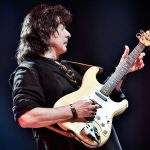
At the core of this elaborate setup is a hefty 1973 Blonde Fender Stratocaster. “It has a 7.25” radius, which requires you to really engage with it. I’ve tried using a PRS for Money and an Ibanez JEM, but they didn’t resonate with me. You need a guitar that challenges you.”
The Strat has undergone six different pickup changes before settling on a Lollar set designed to mimic Gilmour’s cherished EMGs. McDonnell emphasizes, “The choice of strings also plays a crucial role.”
“I’ve experimented with numerous types.I discovered that Ernie Ball Cobalts add a certain grit that complements my Strat’s character. I’ve been mixing and matching string gauges, using 0.12 and 0.16 for the B and G strings instead of the usual 0.13 and 0.17, which considerably impacts my bends.”
No technique is as personal as bending notes; thus, McDonnell had to strike a balance between sounding like Gilmour while remaining true to his own style. “I’m not trying to replicate Gilmour,” he asserts. “I’m expressing myself. Bending is the ultimate form of expression on the guitar-there’s so much conveyed in that motion, and the nuances depend on your emotional state at that moment.”
He advises aspiring guitarists aiming to master Gilmour’s bends: “You must slow down. Allow the bend the time it needs to reach its destination, and once you achieve it, resist the urge to overdo the vibrato; let it evolve into its own expression. Follow the bend’s lead.”