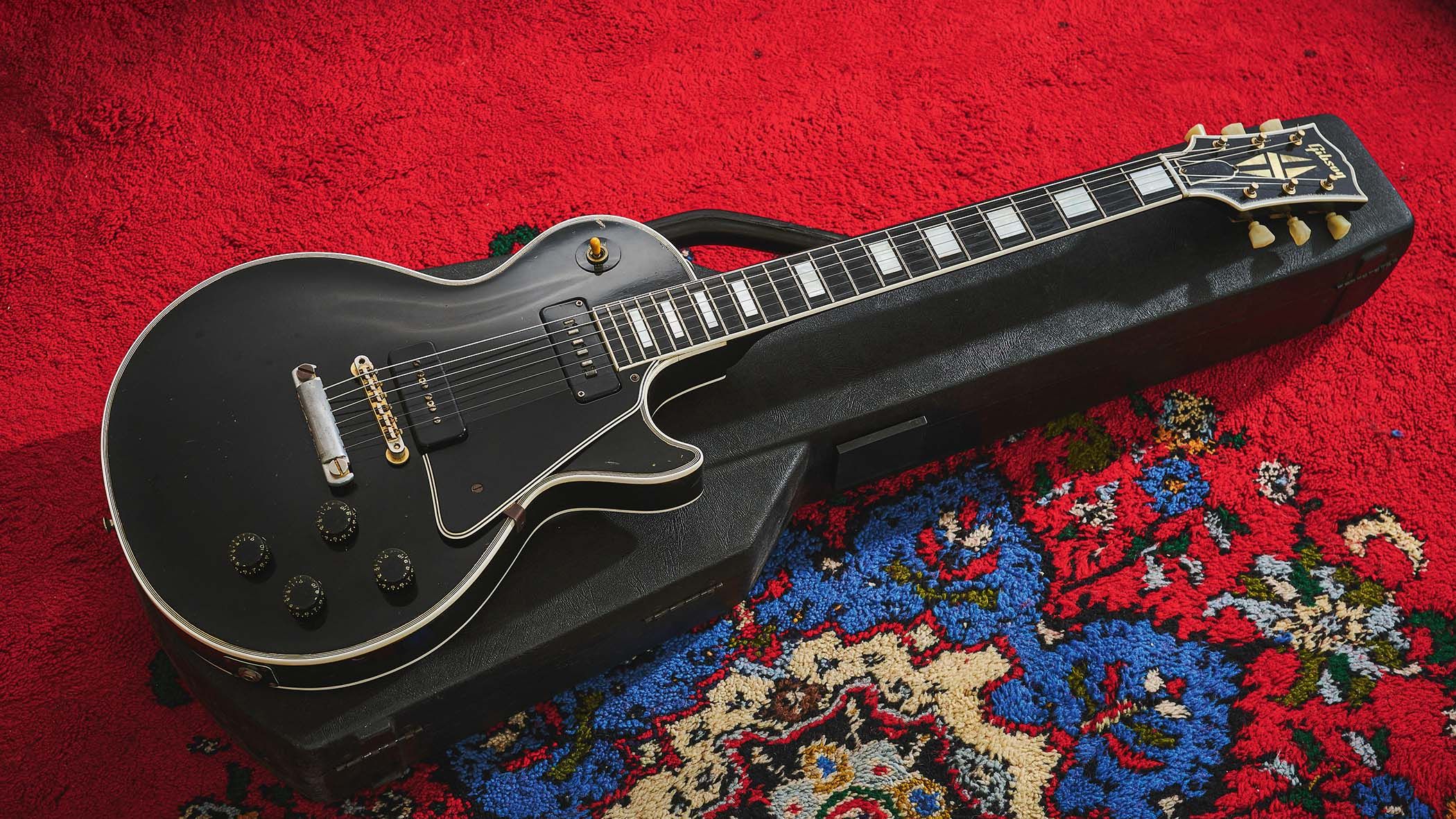
The Legendary Les Paul Custom: A Tale of Two Icons
Les Paul was a man of remarkable talent, but subtlety was not his forte. Instead of gradually introducing the idea of a solidbody electric guitar to loyal Gibson fans,les boldly opted for a striking metallic gold finish on his signature model.In 1952, this guitar would have dazzled like a supernova amidst a sea of muted sunbursts.
With the bar already set high, Gibson faced the challenge of creating an even more luxurious version of Les Paul’s signature guitar. It was as if the design team envisioned the epitome of elegance in musical instruments, perhaps drawing inspiration from a concert grand piano.
Introducing the Les Paul custom
When Gibson unveiled the Les Paul Custom at the 1954 NAMM Show, its glossy black lacquer finish, gold-plated hardware, and intricate multi-ply body binding made it resemble a miniature Steinway. However, this model was not merely a glammed-up version of the Goldtop; it featured several distinct differences.
Distinctive Features of the Custom
One of the most significant changes was in the body construction. Unlike the Goldtops and sunburst Standards that came before it, which were crafted with maple tops, the Custom was carved from a single slab of mahogany. This choice eliminated the dampening effect typically associated with a maple cap.
Changes were also made to the neck. While many 1952 and 1953 Goldtops had significant neck profiles, the Custom often featured a slimmer, faster neck. The fretboard was upgraded to ebony instead of Brazilian rosewood, and instead of celluloid nitrate inlays, Gibson opted for mother-of-pearl blocks with wider binding.
Perhaps the most debated alteration from a modern player’s perspective was the fretwire. Les paul preferred a wider and lower fretwire compared to the smaller wire used on earlier Goldtops, allowing him to execute rapid runs interspersed with jazz chords. Gibson marketed this feature, dubbing it the “Fretless Wonder,” as players praised its low, smooth frets and action. However, for those who enjoy bending strings, the Custom can feel challenging.
This preference for a unique fret design may explain why many prominent musicians of the ’60s and ’70s gravitated towards other models, making Customs less popular and collectible compared to Goldtops and ‘Bursts.
Bridges and Tailpieces: A Controversial Choice
Les Paul’s wrap-under trapeze tailpiece design was met with mixed reviews. While it performed well on models like the ES-225 and ES-295, most players preferred the stability of the fixed wraptail bridge that was introduced on Goldtops in 1953. Some argue that the wraptail is the best-sounding bridge ever fitted to Les Pauls, while others contend that it compromises intonation.
Despite Gibson’s efforts, the introduction of the Tune-o-matic bridge and stoptail combination allowed for individual string adjustments, enhancing intonation.Although the first Gibson to feature a Tune-o-matic was the 1953 Super 400, the Les Paul Custom was the first solidbody to adopt this innovation.
Unique Pickups and Wiring
Another distinctive feature of pre-1957 Les Paul Customs was the mismatched pickups, likely at Les Paul’s request. Early footage of Les playing Goldtops reveals that the neck pickup was not a P-90, but rather a DeArmond Dynasonic concealed under a cream plastic cover.
Instead of simply sourcing Dynasonics from DeArmond, Gibson enlisted Seth Lover to create a Gibson version, resulting in what is now known as the ‘Staple P-90.’ This pickup,while similar in shape,offers a clearer,more high-fidelity sound compared to a standard P-90,reminiscent of the Dynasonic.
Early Customs provide a unique tonal palette, combining the snarl of a regular P-90 with the power of the Staple, creating a delightful mismatch that enhances versatility.
The Blues Legends: Paul Kossoff and Eric Clapton
Despite the unique features of pre-1957 Les Paul Customs, few renowned players are associated with them. Though, the guitar featured here has a remarkable history, having been owned by two British blues legends: Paul Kossoff and Eric Clapton.We spoke with Matthieu Lucas of Matt’s Guitar Shop in Paris to uncover its story.
According to Matthieu, the guitar was brought back to England in late 1965 or early 1966 by Paul Kossoff’s father, David Kossoff, an actor who purchased it from Manny’s in New York. At the time, Paul was playing an SG Junior, making this Custom his first serious two-pickup Les Paul.
In 1966, Paul auditioned for a North London blues band called Black Cat Bones. The band’s drummer, Frank Perry, recalls Paul having a black Les Paul, but he quickly acquired a sunburst model. Given Paul’s young age, it’s likely he traded the black Custom for the sunburst at Selmer’s, where Eric Clapton frequently visited, making it plausible that Clapton ended up with Paul’s guitar.
“Clapton was definitely seen with a 1950s Custom during this period,” Matthieu asserts. “There are numerous photos of him playing a Staple P-90 Custom with Cream at the Marquee Club, and this is the only pre-1957 Custom we certainly know of that he played.”
It was uncommon to see Clapton using P-90 Gibsons during the Cream era, suggesting he was experimenting with various guitars before settling on the Firebird, ES-335, and SG that became his signature during the late ’60s. He did play another black Les Paul Custom with Blind Faith and Delaney & bonnie, but that was a three-pickup 1958 model he later gifted to Albert Lee.
Matt provides further evidence of the guitar’s connection to both legends: “Paul disliked the yellowing binding, so he stripped the lacquer to restore its white color.Clapton’s pictures show the binding as bright white, which it remains today.”
Accounts suggest Clapton left the guitar at the NEMS Organisation, Cream’s agency, in April 1967, as it was no longer needed for an upcoming US tour. This is where Howard ‘H’ Parker enters the narrative, as it’s believed the guitar was transferred to him as payment.
Parker was a familiar face in the late ’60s London music scene,working as a roadie and manager for artists like Hendrix,Pink Floyd,and Cream. He kept the Custom under his bed, and after his passing in 1974, it was passed to his friend John Wilson, who also stored it under his bed for 32 years.
Although aware of the Clapton connection, Wilson had no idea the guitar had belonged to Paul Kossoff until he took it to auctioneers Cooper Owen in 2006. “They discovered Paul’s ownership when they removed the switch and control covers,” Matthieu explains. “Paul would place paper stickers under the covers with his name, serial numbers, and even his address.”
“At one point, it was rumored to have belonged to Duff McKagan,” Matthieu adds, “but I have no proof of that. After Howard Parker, it changed hands several times and eventually made its way to Japan before ending up in Florida, where I purchased it about ten years ago.”
Playing Experience and Legacy
Curious about the guitar’s playability and whether the neck profile differs from the typical 1958 or 1959 ‘Bursts, we asked Matthieu for his insights.
“What’s really nice is that the original frets are almost unplayable… but still very playable at the same time.”
“Actually, I’d say it has quite a beefy neck,” Matthieu insists. ”It’s a joy to play because it features a unique profile. it’s fuller and unlike any other mid-’50s Customs I’ve encountered. If I had to describe it, I’d say it resembles the chunky C profile found on a ’58 Standard.”
“The original frets are nearly gone, especially at the higher notes, which embodies the essence of a Fretless Wonder, yet it remains easy to play. It’s also surprisingly lightweight for a Les Paul Custom,weighing just 3.84 kg, or under 8.5 lbs.”
“All the hardware, frets, pickups, potentiometers, and caps are original to the guitar, along with the finish. It remains exactly as Kossoff and Clapton left it. I do have some photos of Clapton playing it with a white or cream pickguard, but it’s clear this guitar has been either stored under a bed or owned by collectors since then.”
“That’s likely why it has survived in such great condition,” matthieu concludes. “It’s an extraordinary-sounding guitar. Every artist who has played it raves about it, and it has been owned by two legends for a reason. It’s truly a special instrument.”