Introduction
While Leo Fender was busy revolutionizing the electric guitar, he also made a significant mark in the amplifier industry, creating a remarkable legacy of designs that continue to influence musicians today.
The iconic brand began its journey in 1946 with a series of unique combo amplifiers affectionately known as the ‘Woodies’.
Although not a guitarist himself, Leo relied on a close-knit group of trusted musicians, including Fred Tavares and Carl Perkins, to provide insights on the player experience with his instruments. ever the innovative entrepreneur, Leo was always eager to incorporate feedback regarding desirable tones and features. This collaboration led to the introduction of user-friendly front-facing controls on the brown-panel models.
In the early days of audio engineering, achieving sufficient clean headroom was a formidable challenge.However, Leo’s relentless pursuit of excellence resulted in the creation of the iconic ‘Fender Clean Tone,’ which has become a hallmark of the brand. Over the years, the product line has undergone significant cosmetic updates, reflecting the technological advancements within.
On the sonic spectrum, the Woodies and tweed models represent one end with their vintage, low-headroom characteristics, while the black-panel and silver-panel amplifiers showcase the other extreme with their pristine clean tones. nestled between these two extremes are the lesser-known brown-panel models, which we will explore in detail.
These brown-panel amplifiers, produced between 1960 and 1963, are characterized by their warm, woody sound. they offered more clean headroom than their predecessors, transitioning into a beautifully sweet overdrive that later models aimed to suppress.
You’ve likely heard the distinctive brown-panel sound on tracks by a diverse array of artists, including The Beach Boys, Dick Dale, The Stray Cats, and ZZ Top.
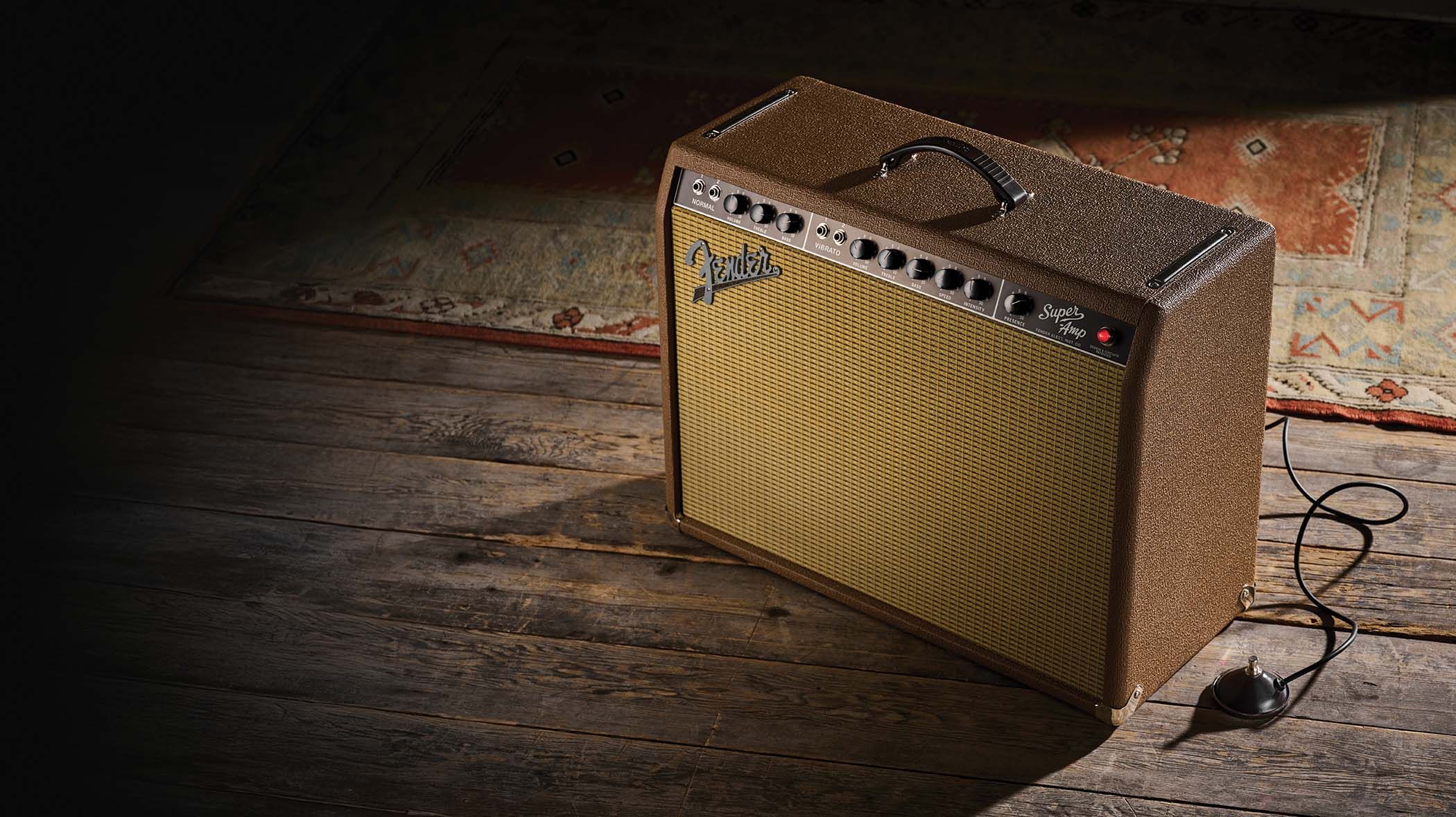
Often rumored to be Leo’s preferred Fender amplifier, the Super model features a pair of 6L6 tubes, delivering 40 watts through two 10-inch speakers, complete with the captivating Harmonic Tremolo effect.
In late 2025, Fender introduced a reproduction of the 1962 Super as part of its premium American Vintage series, which includes meticulously hand-assembled replicas of classic models crafted in California.
For musicians seeking a broader sound dispersion from their combo without compromising on portability,the Super appears to be an ideal solution.
Specifications

- PRICE: $2,499/£2,439
- ORIGIN: USA
- TYPE: All-tube twin-channel combo
- TUBES: 2x 6L6 output tubes, 6x 12AX7 preamp tubes, 1x 5AR4 rectifier tube
- OUTPUT: 40W
- DIMENSIONS: 610 (w) x 267 (d) x 457mm (h)
- WEIGHT: 21.7 kg / 48 lbs
- CABINET: Pine
- LOUDSPEAKER: 2x custom-designed Celestion 10″ speakers
- CHANNELS: 2
- CONTROLS: channel 1 (normal): Volume, Treble, Bass; Channel 2 (Vibrato): Volume, Treble, Bass, speed, intensity, Presence
- FOOTSWITCH: 1-button included
- ADDITIONAL FEATURES: Harmonic Tremolo, cover
- OPTIONS: None
- RANGE OPTIONS: The American Vintage series includes various classic combos from the 50s and 60s: ’57 Custom Champ (£1,409), ’57 Custom Deluxe (£2,359), ’65 Super Reverb (£2,719), and ’65 Twin Reverb (£2,109)
- CONTACT: Fender
Performance and Sound

Our first choice for testing is a Stratocaster. Plugging into the high-sensitivity input of Channel 2 reveals the classic twang across all pickup settings.
The custom-designed 10-inch Celestion speakers produce a surprisingly wide frequency range, enhanced by the solid pine cabinet.
As we increase the volume, we notice the classic subtle sag that responds beautifully to aggressive playing, a hallmark of the period-correct valve rectification. One can only imagine the impact this amp had on a music scene accustomed to the low-headroom tweed models.

Switching to a Telecaster, we find that the amp’s sweeter tones complement it perfectly. At around 7 on the volume, we achieve a wonderfully gritty rock ‘n’ roll sound. It’s tight and aggressive yet retains enough sag to feel responsive and lively.
Plugging in a characterful guitar, such as a DeArmond-equipped Gretsch, reveals a wealth of vintage twang. engaging the Harmonic Tremolo inspires spirited renditions of classics like Born On The Bayou.
Interestingly, Leo Fender mistakenly swapped the terms ‘tremolo’ and ‘vibrato,’ and rather than conform to convention, Fender chose to keep the original labeling.

In this setup, the channel labeled as Vibrato actually utilizes the Harmonic Tremolo, which modulates the bias of the power tubes, creating a rich and dimensional phase-shifting effect alongside the expected volume pulsations.
The negative feedback signal and fixed bias techniques employed in this brown-panel series significantly enhanced headroom, although the technology of the early 60s was not fully capable of realizing Leo’s vision. As we push the volume past halfway, the sound begins to saturate beautifully.
However, things can get quite loud when aiming for those creamy overdrive tones reminiscent of ZZ Top’s Tres Hombres.
Once we hit 7 on the volume,the amp saturates in a distinctly vintage way,which we can only describe as ‘farting out’… While it’s a unique sound,we preferred to stay in the more moderate range.
With our classic Les Paul equipped with a patent Applied For sticker, we find that the sweet spot is around the halfway mark. Going beyond that softens the transients and compresses the dynamics.
Once we reach past 7 on the volume, the amp saturates in a vintage manner, which we can only describe as ’farting out’… While it’s certainly a distinctive sound, we enjoyed staying in the shallower end of this pool.
Finding the balance between feel, tone, and volume is essential to maximizing this amp’s potential.
This amp would be notably well-suited for studio work, where it can be finely tuned to perfection. Despite the warm, rich tones available, this remains a Fender, delivering all the crisp and clear treble you could desire, while the celestion speakers enhance the overall responsiveness and sensitivity.
Conclusion
Conclusion: ★★★★½

This vibrant, brown box of tone captures the essence of the era, delivering everything from finely detailed cleans to rich, warm overdrive. With only a single volume control per channel, be prepared to reach near-gigging volume levels to achieve lift-off. However, these would undoubtedly be enjoyable gigs, aided by the relatively lightweight design of this combo.
As for effects, the Harmonic Tremolo is an unparalleled time capsule of sound, fully realized in this amp. The ‘all-tube’ construction, ‘US hand-assembled craftsmanship,’ and ‘solid wood cabinetry’ are three high-value features that justify this amp’s premium price tag.
Guitar World verdict: This brown-panel classic is the ultimate tool for exploring the sonic landscape between tweed crunch and black-panel clarity, where volume meets saturation, resulting in a wealth of vintage vibe. All aboard the good ship Super. Bon voyage!
Video Demonstrations
Guitarist
Watch On
Fender
Watch On