Introduction
For rock guitarists, the name Eddie Van Halen and the 5150 brand are legendary. This title not only represents the Van Halen album that marked the begining of the Sammy Hagar era but also refers to Eddie’s personal studio and his line of signature amplifiers. The 5150 name has become synonymous with the powerful, high-gain rock sound that Van Halen is known for.
the original 5150 tube amplifier was introduced in 1992, created by Peavey specifically for Eddie. After parting ways with Peavey in the early 2000s, he took the 5150 name with him to establish his own brand, EVH, while Peavey continued to produce its version under the 6505 label.
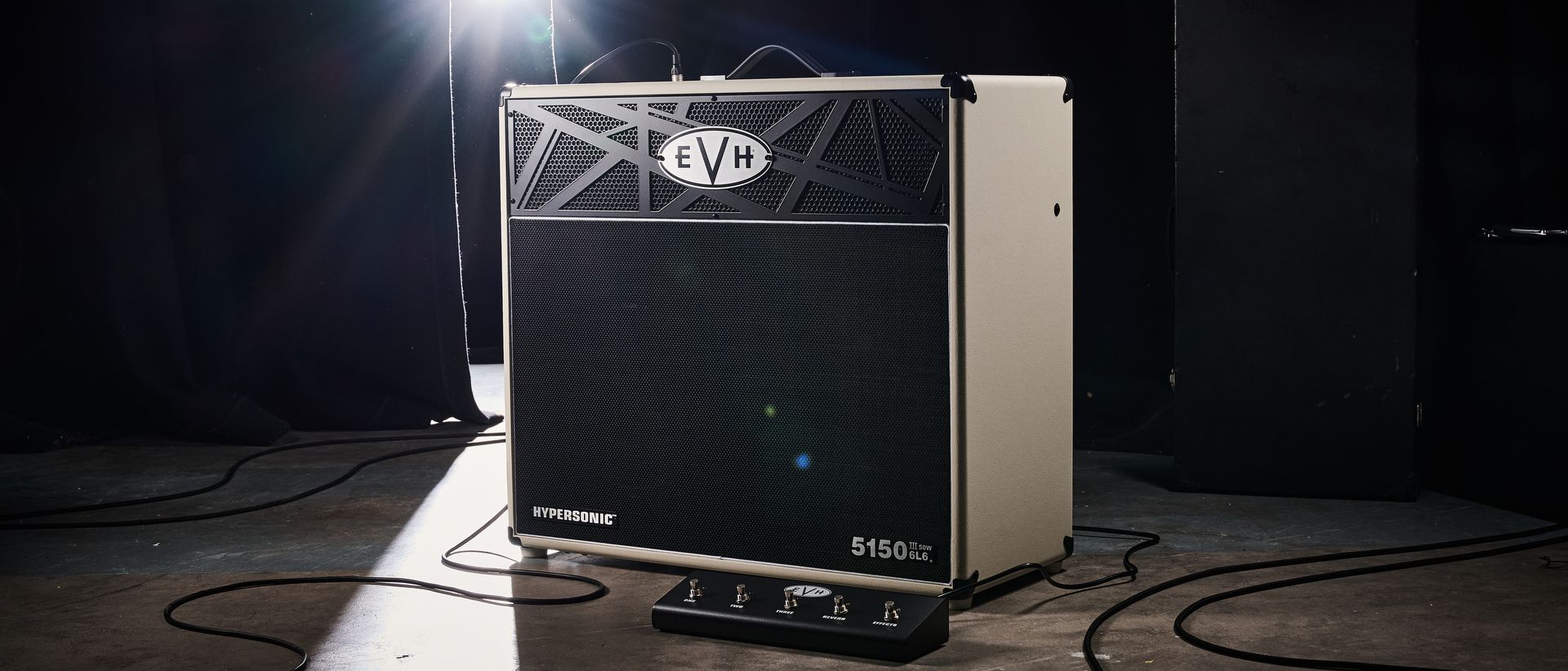
Fast forward to today, and the 5150 III 6L6 amplifier has been modernized with the introduction of the EVH 5150 III Hypersonic 6L6 combos.This new series incorporates digital modeling technology, similar to Fender’s Tone Master range, while still utilizing a real guitar cabinet to create a hybrid combo amp that combines digital precision with analog warmth.


The digital iterations of the 5150 III 6L6 are designed to deliver exceptional accuracy in tone reproduction for two main reasons. First, the digital processing is focused solely on emulating one specific amp, rather than trying to replicate multiple iconic amplifiers and effects, which can dilute the quality.
Secondly, the use of a real cabinet eliminates the need for digital cabinet emulation, placing the player directly in front of two 12″ Celestion G12H speakers. This setup minimizes the digital processing steps between the modeled sound and the listener’s ears. However, the amp does include cabinet emulation for direct recording or live sound applications if needed.
Currently, the Hypersonic series includes the 5150 III FRFR speaker, the 5150 III 6L6 1×12 combo, and the model we are reviewing, the 5150 III 6L6 2×12 combo.Let’s dive into the high-gain tones and see if it meets expectations.
Specifications

- Launch price: $1699 | £1399 | €1625
- Type: Three-channel digital combo amplifier
- Origin: China
- Output: 50 watts
- Speaker: 2×12, Celestion G12H 30W anniversary series
- Channels: Three
- Controls: Independent three-band EQ, Gain and Volume for each channel, Presence, Resonance and Reverb, Power Mode switch, IR selector
- Connectivity: 1/4″ input, IR-loaded XLR output
- Footswitch: Included
- Weight: 56lbs/25.5kg
- Dimensions: 27.5″x11.8″x24.4″
- Contact: EVH
Construction Quality

Build quality Rating: ★★★★
In general, one of the primary advantages of digital technology is enhanced portability; however, this doesn’t hold true for larger digital combos designed to accommodate two 12″ speakers. The EVH 5150 III Hypersonic measures a significant 27.5″x11.8″x24.4″.
Weighing in at 56lbs/25.5kg, it is relatively heavy compared to other digital models (for instance, the 2×12 Boss katana Gen 3 weighs 43lbs), but it represents a significant reduction in weight compared to its tube counterpart, which weighs 85lbs.
Thus, if you’re working with limited stage space, you might want to consider the smaller 1×12 version instead.

I mention stage performance because unless you’re playing live, the added power of the 2×12 configuration may not be necessary compared to the smaller 1×12. EVH has designed the chassis with live performances in mind, featuring robust plywood sides and sturdy metal corner braces.
The large, durable switches for power and mute functions convey a sense of industrial strength, as do the sliders, rotary selectors, and knobs that manage the inputs and outputs on the rear of the unit.

The only aspect that could use some refinement is the chicken head controls on the top half of the dual concentric setup. They feel slightly loose compared to the other controls, lacking the premium feel that the rest of the amp offers.
Fortunately, the lower dual controls for the Green channel (channel one) and the standalone chicken head knobs for the Red channel (channel three) do not share this issue and maintain the high standard set by the amp.
Functionality and Features


Usability and Features Rating: ★★★★☆
Digital technology offers the advantage of incorporating additional features, and the EVH 5150 III Hypersonic takes full advantage of this. It faithfully replicates the original amp while adding modern conveniences, including three footswitchable channels, each equipped with its own gain and Volume controls, a master Presence and Resonance control, an effects loop, a robust footswitch, and MIDI connectivity.
For reference, the channels are designated as green, Blue, and Red-Green for clean tones, Blue for rhythm, and Red for lead.

This digital model also boasts a three-band EQ for each channel (unlike the tube version, where channels one and two share an EQ), a noise gate for each channel, and a speaker-emulated XLR output featuring two built-in Impulse Responses (IRs).
For silent stage setups using just the XLR output, a mute switch is conveniently located on the back.
These IRs can be modified using the EVH IR manager app, which requires a firmware update for the amp. While the update process is straightforward, it would be beneficial to have clearer instructions in the included manual, as this is a necessary step for all users.

One notable absence is a Master volume control. With three channels each having their own volume settings, a master volume would be useful for adjusting the overall output without disturbing the balance between channels.
While adding a Master volume to a tube amp can introduce complications depending on its circuit placement, this is a digital amp, making it feel like a missed opportunity.
However, the advantage of this amp’s traditional design is the absence of complex menus or screens. It combines the benefits of digital modeling with the straightforward plug-and-play approach of classic tube amps.
Generally speaking, you simply plug in your guitar, adjust the EQ, gain, and volume to your preference, and you’re ready to rock. This simplicity is refreshing compared to increasingly complicated digital pedalboards.
Having mentioned that, there are a few quirks to navigate.

The primary concern is with the chicken head knobs located atop the dual concentric controls for EQ, Gain, and Volume on the Green and Blue channels. The Green channel is adjusted using the lower control, while the Blue channel is modified via the chicken head knob above it (the Red channel has its own dedicated knobs).
The larger size of the chicken head knobs can obstruct access to the lower controls, making adjustments cumbersome.
The chicken head knobs are larger than the control below it, making it difficult to adjust the lower control.
This design flaw is frustrating, especially since similar controls have been effectively implemented by brands like Boss in pedals such as the JHS Angry Driver. The concept is solid, but the execution on the EVH could use improvement.
Switching channels with the footswitch is straightforward,with an LED indicator showing the active channel. Without the footswitch,the LED is integrated into the mini rotary knob that controls the noise gate for each channel.

Initially, I found this setup confusing, mistakenly assuming that an LED on the noise gate control indicated whether the gate was active.In reality, the noise gate is always engaged (you can turn the dial to zero to deactivate it), and the LED simply shows which channel is currently selected.
On a positive note, the noise gates are easy to use and are particularly beneficial for an amp with such high gain. EVH has opted for simplicity, avoiding complex parameters like attack and release, and rather provides a single mini knob to adjust the gate’s intensity.

Assuming the more detailed parameters are well set (which they are, as we will discuss later), you only need to adjust the relevant gate until the hiss disappears. This simplicity is appreciated, especially with three independent gates for each channel.
The three channels, each with their own EQ and volume controls, make this amp a versatile option for live performances, providing clean, rhythm, and lead tones without the need for additional pedals.
That said, many players might still prefer to have a pedalboard with effects like phasers and delays, and for that, an effects loop is conveniently located on the back for easy integration.
Sound Quality

Sound Quality Rating: ★★★★
Things can get a bit muddy in the low mids when the gain is pushed past halfway, so caution is advised.
When running clean, the green channel lacks some harmonic richness that typically brings a clean tone to life. However, as you increase the Gain, it begins to growl, producing a satisfying high-end that pairs well with a tight low end, resulting in a rewarding pushed clean tone.
Testing with both a Gibson SG and a Music Man Silhouette Special, I noticed that the low mids can become muddled when the gain exceeds a certain threshold.
When it comes to tone shaping, the three-band EQ on each channel offers robust High and Mid controls, while the Low control is more subtle. Additionally, the master Resonance and Presence controls are designed to be conservative, allowing you to manage the low-end punch and airy highs without overwhelming your tone.

Let’s be honest-most players are drawn to this amp for its driven tones, and it certainly delivers. The Blue channel instantly provides a significant boost in gain, transitioning from a heavy crunch to full-on distortion within the first half of its range, and continues to offer more than enough gain as you push it further.
what makes this amp enjoyable to play is its tightness; there’s no flabby low end here, allowing you to fully utilize the neck pickup. When using a bridge humbucker, it excels at producing that chugging, high-gain sound reminiscent of 80s rock, with palm mutes benefiting from its precision.
The Red channel is akin to the Green channel but enters distortion territory sooner and features a slightly more pronounced mid-range, all while maintaining a tight low end. In essence, it’s the ideal choice for high-gain leads.

Additionally, there’s a simple digital reverb included, which features a single control for adjusting the amount. It’s voiced to maintain a controlled low end, ensuring clarity even at higher settings. While it may feel slightly detached from the dry signal at lower levels, it’s not a significant issue.
As mentioned earlier, the XLR output on the back comes with two stock IRs based on the EVH 5150 III cabinet and speaker-one utilizing an off-axis SM57 and the other an on-axis SM7B.
Both IRs are impressive, but I personally prefer the on-axis SM7B for its rounder tone and reduced digital fizz. Utilizing the high cut feature in the IR Loader app is a great way to mitigate any unwanted artifacts.
When compared to a real cabinet, both IRs exhibit slightly less pronounced mid-range, which is expected when capturing sound through a microphone rather than standing in front of the actual cabinet.
The IR Loader app also allows users to upload their own IRs, providing flexibility if the stock options don’t meet your needs. Personally, with a little high cut adjustment, I would be comfortable using the built-in irs for direct-to-desk applications.
Final Thoughts

The legacy of the 5150 name carries significant expectations, conjuring images of Van Halen and exceptional high-gain tones. Fortunately, the EVH hypersonic 5150 III 6L6 lives up to this reputation.
While I’m not particularly fond of the Green (clean) channel, the tight, high-gain sounds from the Blue and Red channels are what truly shine.
with three channels, each featuring its own noise gate and EQ, along with a direct-to-desk XLR output equipped with quality pre-loaded IRs, this amp is an essential tool for any high-gain guitarist, whether performing at high volumes or in silent stage settings.

Ultimately, when using the cab, I completely forgot it was a digital amp.
The true advantage lies in removing cabinet emulation from the digital realm and running a modeling amp through a real guitar cabinet and speaker.Much of the “amp in the room” experience comes from being in front of a real cabinet, making this digital combo feel authentic.
while playing through the cabinet, I lost track of the fact that it was digital.
The reality is that vacuum tubes won’t last forever.However,if this represents the future of guitar amplification,I’m more than willing to embrace it.
Guitar World Verdict: The EVH 5150 III Hypersonic 6L6 combines the advantages of a modeling amp with the authentic feel of a real speaker cabinet. It performs like a traditional amp in a room while offering the benefits of digital technology, such as an IR-loaded XLR output and adjustable power modes. Despite a few usability quirks, it stands as an excellent solution for any high-gain guitarist.
|
Test |
Results |
Score |
|---|---|---|
|
Build Quality |
It feels robust and industrial, though some knobs could feel more premium. |
★★★★ |
|
Usability and Features |
Offers ample features for live shredding, but some controls can be frustrating. |
★★★★☆ |
|
Sound Quality |
The clean channel is somewhat underwhelming, but the distortion is excellent and iconic. |
★★★★ |
|
Overall |
A remarkable digital interpretation of the 5150, reassuring for those considering moving away from tube amps. |
★★★★ |
Also Try
Hands-on Videos
Dagan Wilkin
Unleashing the Sound: A Deep Dive into the EVH 5150 III Hypersonic 6L6 2×12 amp!
Overview of the EVH 5150 III hypersonic 6L6 2×12 Amp
The EVH 5150 III Hypersonic 6L6 2×12 amp is a powerful combo amplifier designed for guitarists seeking high-gain tones with exceptional clarity and versatility. This amp is part of the renowned EVH line, created by legendary guitarist Eddie Van Halen, and it embodies the spirit of rock and roll.
Key Features
- Three Channels: Clean (green), Rhythm (Blue), and Lead (Red) channels, each with independent Gain and Volume controls.
- Powerful EQ: Each channel features a three-band EQ for precise tone shaping.
- Digital Reverb: Simple one-knob control for adding depth to your sound.
- IR-Loaded XLR Output: Two built-in impulse responses for direct recording or live sound applications.
- Robust Build Quality: Designed to withstand the rigors of touring and live performances.
Sound Quality
The sound quality of the EVH 5150 III Hypersonic 6L6 2×12 amp is nothing short of remarkable.Here’s a breakdown of each channel:
Green Channel (Clean)
The Green channel offers a clean tone that is luminous and articulate. while it may not be the standout feature of the amp, it provides a solid foundation for rhythm playing and clean passages.
Blue Channel (Rhythm)
The Blue channel is where the amp truly shines. It delivers a rich, crunchy tone that can easily transition from classic rock to heavier styles.The gain control allows for a wide range of distortion, making it perfect for power chords and melodic riffs.
Red Channel (Lead)
The Red channel is designed for high-gain leads, offering a pronounced mid-range and tight low end. This channel excels at producing soaring solos and aggressive riffs, making it a favorite among shredders.
Benefits of the EVH 5150 III Hypersonic 6L6 2×12 Amp
- Versatility: With three distinct channels, this amp can handle a variety of musical styles, from blues to metal.
- Portability: The 2×12 configuration strikes a balance between sound quality and portability, making it ideal for gigging musicians.
- Ease of Use: The intuitive layout allows for rapid adjustments, enabling players to focus on their performance rather than technicalities.
- Durability: Built with high-quality materials, this amp is designed to withstand the demands of live performances.
Practical Tips for Using the EVH 5150 III Hypersonic 6L6 2×12 Amp
- Experiment with EQ Settings: Take the time to dial in your EQ settings for each channel. Small adjustments can lead to notable changes in tone.
- Utilize the Noise Gate: Each channel has its own noise gate, which is essential for maintaining clarity, especially at high gain levels.
- Explore the IR Options: Use the built-in impulse responses for direct recording or live sound. Experiment with different settings to find your ideal tone.
- Maintain Your Gear: Regularly check and maintain your amp to ensure optimal performance. This includes cleaning the inputs and outputs and checking for any loose connections.
Case Studies: Real-World Applications
Many professional guitarists have adopted the EVH 5150 III Hypersonic 6L6 2×12 amp for its reliability and sound quality. As an example, renowned guitarist Joe Satriani has praised the amp for its ability to deliver a wide range of tones suitable for both studio recordings and live performances.
First-Hand Experience
During a recent jam session, I had the possibility to test the EVH 5150 III Hypersonic 6L6 2×12 amp. The transition between channels was seamless, and I was especially impressed with the clarity of the Blue and Red channels. The amp handled palm muting exceptionally well, providing a tight response that made playing intricate riffs a breeze.
Technical Specifications
| Specification | Details |
|---|---|
| Type | Digital Combo Amp |
| Output Power | 50 Watts |
| speakers | 2×12″ Celestion G12H |
| Channels | 3 (Green, Blue, Red) |
| Weight | 56 lbs (25.5 kg) |
| Dimensions | 27.5″ x 11.8″ x 24.4″ |
Join the Beatbounty Community
If you’re passionate about music and looking to connect with other musicians, consider creating an account on the Beatbounty platform. you can submit ads, collaborate with fellow artists, and explore new opportunities in the music industry.
Become a valued member of Beatbounty platform.
Start selling and connect with fellow musicians – LOGIN or REGISTER!