Introduction
Few could have predicted that Ed Sheeran would venture into the world of baritone guitars when he partnered with PRS in 2019. Yet, here we are, exploring the PRS SE Ed Sheeran Hollowbody I Piezo Baritone. This marks EdS inaugural signature electric guitar, and it has certainly caught the attention of the guitar community.
fans of racing may recall Ed showcasing a custom-built Rosso Corsa baritone in the music video for his track ‘Drive‘. Although that guitar differs significantly in specifications, the excitement generated by that instrument paved the way for the SE model we have today.
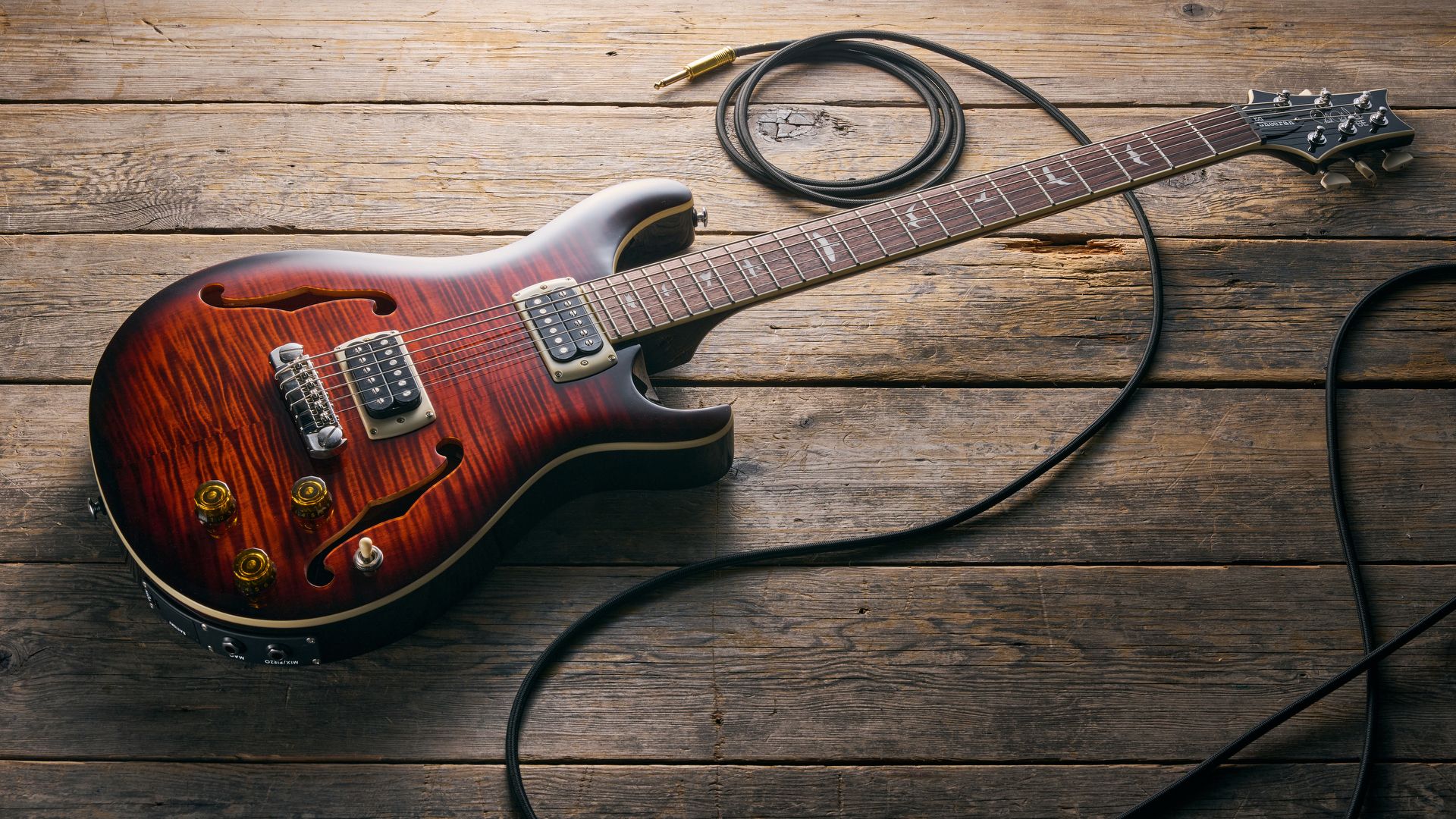
The SE Ed Sheeran baritone showcases a hollow body design featuring a flat back made from a maple top with a flame maple veneer, complemented by mahogany back and sides. It includes a center block, a shallow violin carve on the top with cream binding, and dual f-holes that lack the binding found on the popular Hollowbody II models.

The neck is crafted from maple and features the familiar PRS Wide Fat profile. It boasts a rosewood fretboard with a 10-inch radius, cream binding that complements the body, and the iconic PRS bird inlays. The set neck has a scale length of 27.7 inches, designed to accommodate the lower tunings typical of baritone guitars.
The tuners are PRS-designed, featuring wider ‘winged’ buttons compared to the standard oval shapes found on many PRS guitars. The bridge is a PRS adjustable stoptail equipped with a PRS/LR Baggs piezo system under the saddle, while the pickups consist of two 85/15 “S” humbuckers.
Individual volume controls for both the piezo and magnetic pickups are paired with a master tone control and a 3-way toggle switch. There are two output jacks available,allowing for a mix of piezo and magnetic pickups or magnetic pickups alone.
Specifications

- launch price: $1,499 | £1,499 | €1,799
- Manufactured in: Indonesia
- Type: Six-string hollow body baritone guitar
- Body: Maple top with flame maple veneer, mahogany back
- Neck: Maple set neck / Wide Fat profile
- Fingerboard: Rosewood
- Scale length: 27.7″, 703mm
- Nut width: PRS synthetic / 43mm
- Frets: 22, PRS standard fret wire
- Hardware: PRS-designed tuners, PRS adjustable stop tail piezo bridge
- String spacing at bridge: 52mm
- Electronics: 2x 85/15 “S” humbuckers, magnetic volume, piezo volume, tone control & 3-way toggle pickup switch
- weight: 6.6 lbs / 3 kg
- Options: N/A
- Left-handed options: N/A
- Finishes: Orange Tiger Smokeburst (as reviewed), Kaleidoscope, Pink Ombre
- Included: PRS gig bag
- Contact: PRS
Quality of Build

Build Quality Rating: ★★★★½
As with every PRS SE model I’ve encountered in recent years,the build quality is nearly impeccable.A close examination reveals a minor black speck in the binding on the bass side where the neck meets the body, and a slight paint bleed on the treble side at the same junction. Other than that,the aesthetics are flawless.
Despite its hollow body construction, it has a solid feel, weighing in at 3kg. This contributes to a sense of durability. The lower cutaway features sculpting for easier access to the upper frets, while a subtle belly cut on the back enhances comfort. The knobs are well-placed, and the toggle switch clicks satisfyingly through its three positions.

The output jack configuration is unique, featuring two outputs: one labeled ‘mix/piezo’ and the other ‘mag’. Both are oriented for easy reading from the player’s viewpoint, which is a thoughtful design choice.A compartment houses a 9V battery that powers the piezo preamp, activated only when plugged into the ‘mix/piezo’ jack, allowing for passive use with the other output.
Playability

Playability Rating: ★★★★½
Its not quite flexible enough for serious shredding
When I settled down to play the Ed Sheeran Hollowbody baritone, the neck felt notably thicker compared to the standard-scale guitar I had been using. while it’s not excessively bulky, it does feel considerable in my hand as I strum open chords. It certainly doesn’t cater to the ‘shredders’ aspect of the marketing claims as I attempt some legato and three-note-per-string runs.
While I can navigate lead work fairly quickly, it lacks the flexibility needed for intense shredding. Jumbo frets might have enhanced this, allowing for quicker movement across the fretboard, but as it stands, I would hesitate to label this a shred guitar. Measuring the action reveals it to be around 2mm, indicating room for advancement in that area.

Bending notes is easier than on some other baritones I’ve tried. Achieving a full tone with a supporting finger or two is quite manageable, and I don’t feel like I have to struggle to get those bends. However, reaching the 22nd fret requires a slight adjustment, as my hand tends to hit the non-sculpted area of the cutaway. A slight tilt when reaching for that fret resolves this issue, and I quickly find myself hitting it consistently.
Switching to drop A tuning and playing some riffs reminiscent of ‘Ashes of the Wake’ by Lamb of God is incredibly satisfying. The thicker neck profile provides a solid anchor for alternate picking and palm-muted riffs, making it enjoyable to play. Although the scale length is longer than a standard PRS, it strikes a nice balance between length and string tension with the factory-installed 14-68 gauge strings.
Sound Quality

Sound Quality Rating: ★★★★½
Eager to explore the piezo pickup, I connect it directly to a Fender 64 Princeton reissue to assess the clean tones.Engaging only the piezo pickup, the treble notes sound fantastic, with minimal of the ‘plink’ often associated with this type of pickup. However,the lower strings don’t resonate as well,often getting overshadowed when I play arpeggiated open chords.
Incorporating the magnetic pickup restores some of the low-end richness, resulting in a fuller overall sound. When I switch to the neck humbucker with both volume knobs maxed, the tonal blend of the bright piezo and warm neck humbucker is delightful, encouraging me to play arpeggios for an extended period. Adding spring reverb and a touch of tremolo from the amp creates a clean tone paradise.
The tone control only affects the magnetic pickups, and rolling it back while combining with the piezo adds critically important versatility to the guitar. Switching back to just the neck humbucker feels somewhat dull in comparison, partly becuase the piezo increases the overall volume, which often translates to a more appealing sound to the human ear.

I discover a remarkably smooth lead tone from the humbuckers
Using my Joyo Klon clone in front of the amp and cranking up the volume, I find a remarkably smooth lead tone from the humbuckers. Even with some drive applied to chords, they maintain clarity, but this changes when I introduce the piezo. Here, it can feel overwhelming, as the individual strings can get lost due to the extra high-end introduced by the piezo. It also becomes a bit too pronounced on lead work, with the piezo’s pluck becoming more prominent when overdrive is added to the signal chain.
Increasing the gain on the amp and my overdrive pedal, slow, heavy power chords sound powerful, and adding the piezo gives them a clank that suits this style well. Curious to see if this guitar can handle djent tones, I switch to my audio interface and Nolly’s Neural DSP plugin.

With the 5150 model selected and the bridge humbucker engaged, a solid metal rhythm tone emerges. The low tuning naturally aids this, but the mid-gain pickups maintain articulation. I need to tweak the settings a bit to achieve the desired tightness, but it’s more than adequate for tracking chugs.It also excels for leads,preserving that smooth sound and feel when I add reverb and delay.
Lowering the low string to an octave below ‘E’ (similar to a standard bass) remains surprisingly stable for djent tones. However, the humbuckers alone lack the definition needed for this style of riffing.
Incorporating the piezo restores some clarity, adding the characteristic clank associated with many down-tuned modern metal sounds. While it can handle these tones, it may not be entirely practical, as it lacks the natural compression of active pickups, making it challenging to control extraneous noise with a high-gain amp.
Conclusion

The PRS SE Ed Sheeran baritone is likely to attract a diverse audience across various genres,provided you can overlook the name on the headstock.If you can set aside any biases, you’ll discover a well-crafted guitar with a comfortable neck capable of producing a wide array of tones.
It’s not quite suited for true djent tones or extreme shredding
While the marketing narrative of appealing to both singer-songwriters and metal enthusiasts holds some truth, it falls short of delivering authentic djent tones and high-speed shredding, primarily due to the pickups and neck profile. Nevertheless,for nearly any style,you’ll find a sound here,and perhaps some truly unique tones when blending in the piezo pickup.
Guitar World Verdict: While it may be the unexpected guitar, the PRS SE Ed Sheeran Hollowbody I Piezo Baritone is a highly capable instrument.with the renowned PRS build quality and the added versatility of the piezo bridge, it serves as a tool for singer-songwriters and a solid option for metal chugging. It may not fully meet the demands of shredders or djent players, but it certainly covers a broad spectrum of musical styles.
|
Test |
Results |
Score |
|---|---|---|
|
Build Quality |
Typical PRS craftsmanship, with minor finish imperfections |
★★★★½ |
|
Playability |
Thicker neck profile is excellent for most styles, but not agile enough for shredding |
★★★★½ |
|
Sound Quality |
pickups are highly versatile, and the piezo adds unique tonal options |
★★★★½ |
|
Overall |
A fantastic baritone guitar that excels in various roles |
★★★★½ |