The Sonic Journey of Jack Casady: Exploring His Iconic Bass gear
Between 1965 and 1972,Jack Casady transformed the landscape of electric bass playing,pushing the boundaries of both artistry and technology. As a key figure in Jefferson Airplane, he played a pivotal role in shaping the ‘san Francisco sound’ before teaming up with guitarist Jorma Kaukonen to form Hot Tuna.
Grace Slick, the band’s vocalist, once remarked, “Jack had this roaring, growling thing that would start at the bottom and twine all the way up. I’d never heard bass like it.” This statement, found in the booklet for Jefferson Airplane Loves You, encapsulates the unique sonic signature Casady brought to the group.
Casady’s journey began with a Fender Jazz Bass from the early ’60s, which was unluckily stolen. By the time they recorded Jefferson Airplane Takes Off, he had replaced it with another Jazz Bass, typically paired with a Fender Bassman amplifier.
In a 2022 interview with Bass Player, Casady shared, “I played the first three albums with that Jazz Bass with a P-pickup in it, so it was really a three-pickup instrument.” His initial amplifier was a 50-watt Fender Bassman, complemented by a custom-built 4×10 extension cabinet crafted by his father, which was “loud as hell and looked like a coffin!” this cabinet was designed to fit snugly in the back seat of his 1950 Pontiac.
During the recording sessions for After Bathing at Baxter’s in 1967, amp designer Bob Hall introduced Casady to the Versatone, a 40-watt stereo tube amplifier originally intended for acoustic bassists. The amp’s outputs were merged into a single custom 12-inch Utah speaker, and Casady was immediately captivated by its capabilities. “Jack turned the thing all the way up!” Hall recalled in a 1993 interview with Bass Player. “I didn’t know why you’d want to do that – but as long as he bought the amp, it was his business.”
The Versatone became integral to Casady’s sound, allowing him to explore a more nuanced approach to volume control. By setting the amp to half power, he achieved a distortion effect that only kicked in when he played with more intensity.
While the Jazz Bass remained his primary instrument during the recording of After Bathing at Baxter’s, he began experimenting with a Guild Starfire Bass towards the end of the sessions. This bass underwent critically important modifications thanks to Augustus Stanley Owsley and ron Wickersham, who implemented a variable-Q resonance filter and Darlington emitter-followers to enhance its output.
The modified Starfire, affectionately nicknamed ‘Mission Control’ (distinct from Phil Lesh’s Alembic), was refinished by luthier Roy Noble and featured an intricate headstock inlay designed by Jorma Kaukonen’s wife and executed by inlay artist Chuck Erikson. Casady utilized this instrument for the next three Jefferson airplane albums until it was stolen shortly after Woodstock,prompting him to acquire another Guild,a sunburst model from 1968 or 1969,which he promptly sent back to Wickersham for modifications.
With no time for extensive woodworking, Wickersham quickly adapted the new bass by cutting out the top around the lower f-hole and installing three magnesium channels for the controls. “Back in those days we were chasing a hi-fi sound – we were trying to get better fidelity all the time,” Casady explained. “I learned all that from my father,who was a dentist but also an audiophile. He loved to build amplifiers and assemble sound systems to enhance fidelity.”
Casady played this Guild until early 1972, when he acquired his first Alembic bass. This instrument was groundbreaking, being the first all-Alembic model, crafted by Rick Turner with custom-designed pickups and advanced electronics by Wickersham. It featured adjustable pickups on sliding rails and interchangeable bridge saddles made from various materials.
However, after a mishap where the bass was dropped onto a concrete floor, Casady noted, “it never sounded the same after that.” He later transitioned to a Flying-V bass, constructed from mahogany by luthier Glenn Quan, paired with a short-scale Guild neck and vintage Guild pickups, which he used during Hot Tuna’s more hard-rocking phase.
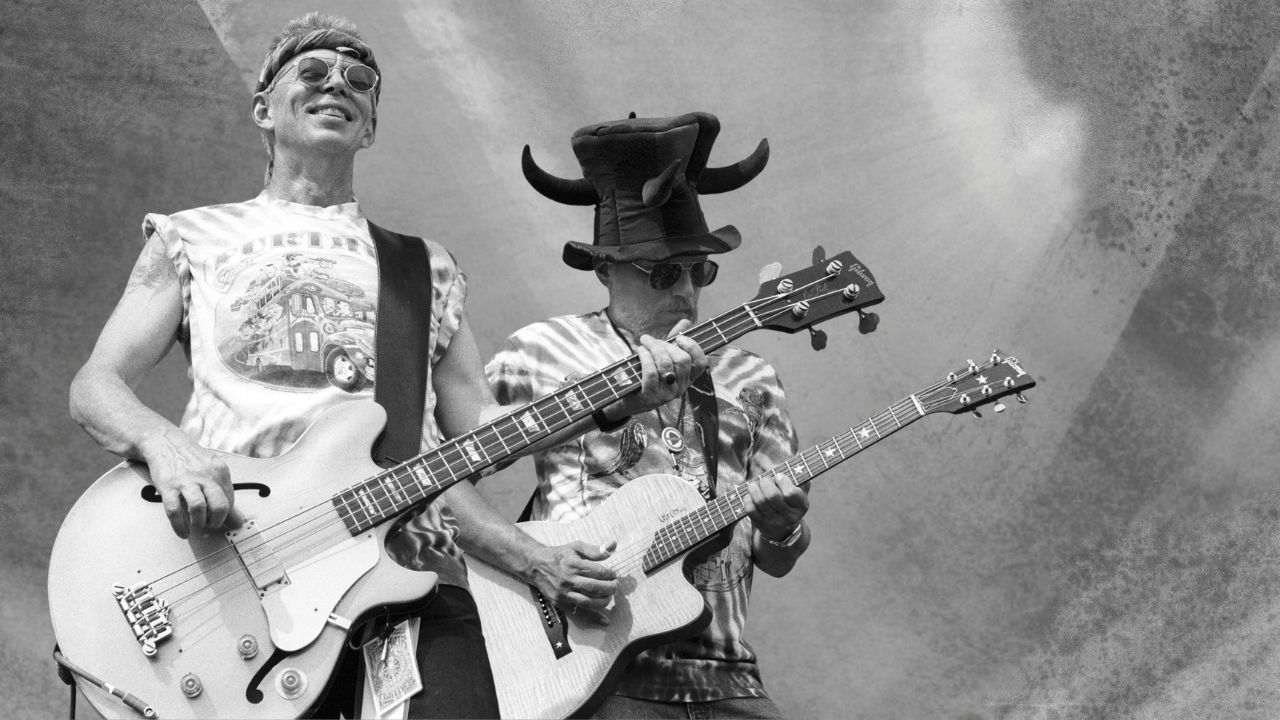
As his career progressed, Casady experimented with several instruments, including Modulus Graphite P-style basses and a Stars Guitars P that was stolen after a performance in West Hollywood. Following the reformation of Hot Tuna in 1985,he opted for a Guild B-30 acoustic bass guitar equipped with piezo pickups. In 1986, while in New York City, he discovered a 1971 Gibson Les Paul Signature bass at Chelsea Music, which quickly became his go-to instrument due to its long scale and semi-hollow design.
Casady’s passion for semi-hollow basses culminated in the release of an Epiphone signature model in 1997, closely resembling his beloved Gibson Les Paul from the ’70s. This model has received consistent praise and remains a favorite among bassists.
“I love electric instruments with acoustic properties. And with the Les Paul,I finaly found a bass that’s responsive enough to capture all the subtleties of my sound and style,from the high-end to the low-end,” Casady expressed.He collaborated with Gibson to reissue the bass, working with Jim rosenberg at Epiphone to replicate the original pickups while enhancing them with additional Alnico power.
“I also wanted a long-scale f-hole bass out there. The Guild f-hole guitar wasn’t a true hollow body; it had a block down the center. But this instrument still has an acoustic quality, and that’s why I think it sounds so good along with the pickup.”