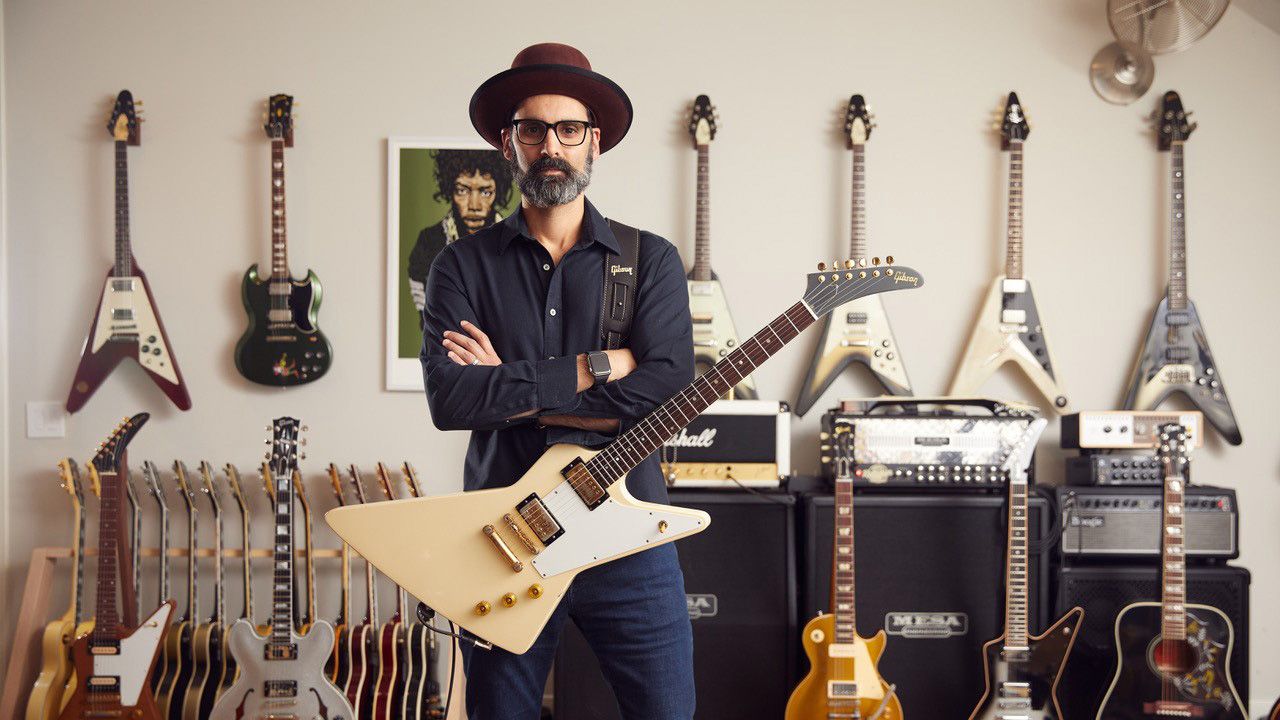
Recently, Cesar Gueikian revealed his decision to resign as CEO of Gibson, marking the end of a transformative era for the iconic guitar manufacturer.
his tenure at Gibson has been nothing short of revolutionary. Future historians will undoubtedly distinguish between the company’s trajectory before and after his leadership. Gueikian’s ascension to the CEO role in 2023 was a defining moment for the Nashville-based brand.
What set Gueikian apart was his unique approach to leadership. His mantra, “Do epic shit,” reflected his outlook as a musician rather than a conventional corporate executive.
As Gibson’s chief promoter, his social media presence provided an inside look at the company’s daily operations, from factory tours to personal guitar demos and live performances alongside Gibson artists.
While many refer to the production facility as a factory, Gueikian preferred the term ”craftory,” emphasizing the artistry involved in guitar making.
“I called our production facilities craftories from the start as I struggled to except the term factory,” he shared with MusicRadar.
Although this term didn’t gain traction outside the nashville headquarters, Gueikian had more meaningful challenges to tackle.
Previously serving as CMO under CEO James ‘JC’ Curleigh, Gueikian made his vision clear upon taking the helm.He criticized the brand’s previous ownership for losing sight of its core mission: “to create the finest guitars ever made.” He was persistent to steer the company back on course.
“Quality is not just about how the guitars are constructed; it’s also about what we produce,” he stated.
Quality control had long been a contentious issue for Gibson, which struggled to adapt to the digital age. Past missteps, such as the ill-fated self-tuning electric guitar, had tarnished the brand’s reputation. Gueikian was committed to reversing this trend.
Did he succeed? Absolutely. He leaves Gibson in a substantially stronger position, and here are five key ways he reshaped the brand.
1. Revamping Quality Control
Head over to YouTube, and you’ll find countless videos critiquing Gibson’s quality control-a genre all its own. When a Gibson USA guitar has finish flaws or other issues, it quickly becomes a talking point.
Quality control had been a persistent problem, especially during the tenures of Henry Juszkiewicz and David H. Berryman. In 2019, shortly after taking over as CEO, James ‘JC’ Curleigh announced that the new leadership team had “declared war on dust” in the factory, implementing various measures to enhance quality.
Under Gueikian’s leadership, significant investments were made to bolster quality control. He brought in Jeremy Freckleton, a manufacturing production expert, and centralized the quality control team to oversee operations across Gibson USA’s Nashville factory, the Custom Shop, the acoustic guitar facility in Bozeman, Montana, and its partners in China for Epiphone guitars.
“Our quality team now serves every brand, category, and collection, ensuring quality checks at every stage of guitar production,” Gueikian told Guitarist in 2022.
A training center was established, incorporating insights from master luthiers like Jim DeCola, Keith Medley, and Tom Murphy. Gueikian’s era concludes with Gibson enjoying a renewed trust in its quality control.
Interestingly, gueikian expanded the definition of quality control beyond standard procedures to include the actual product lineup, leading us to the next point.
2. Restoring Gibson’s Identity
Gueikian recognized the importance of Gibson’s rich history in shaping its future.
“Quality is not solely about the construction of the guitars; it’s also about the products we offer,” he explained. ”We need to create guitars that embody the essence of what makes a Les Paul Standard, for instance.”
The product lineup was streamlined, categorizing Gibson USA offerings into the Original Collection, Modern Collection, and artist Collection. The Custom Shop range followed a similar structure. Guitars that had faded into obscurity, like the Victory, were reintroduced, and the long-awaited Theodore model finally went into production based on an old design.
The revival of the Theodore was significant, symbolizing Gibson’s commitment to producing instruments that musicians genuinely want to play. The ES-330 also made a comeback!
moreover, the expansion of the Murphy Lab project, notably with its limited-edition artist models, demonstrated a thriving market for high-end collectible guitars, indicating ample room for growth at the top end of the price spectrum.
While these premium models may be out of reach for many, the entry-level Gibson USA lineup was also expanded, and the change of epiphone-with its open-book headstocks and Inspired by Gibson Custom lineup-provided a taste of the Gibson experience at a more accessible price point.
3.Strengthening Relationships with Artists
During Gueikian’s leadership, gibson’s artists became more integral to the brand than ever before. The company introduced a greater number of signature guitars and even launched its own record label, with Slash as its inaugural signing.
The collaboration with Gibson artists provided a wealth of design inspiration that permeated the product catalogue.
partnerships with artists like Slash, Adam Jones, Kirk Hammett, and Jerry Cantrell deepened, resulting in Custom Shop replicas of thier signature models, more affordable Gibson USA versions, and Epiphone alternatives for younger players and budget-conscious musicians.
“When I first met Cesar, I was amazed by his extensive knowledge and unwavering commitment to music,” Jones remarked. ”Cesar’s integrity and passion for Gibson’s legacy are commendable. I’m proud to know him,and our working relationship has blossomed into a genuine friendship.”
4. Mastering the Art of Storytelling
This narrative centers around a CEO,so let’s take a moment to reference Wall Street,quoting Leonardo DiCaprio’s character Jordan Belfort in The Wolf of wall Street,who famously said,”I never ask my clients to judge me on my winners. I ask them to judge me on my losers, as I have so few.”
This perspective can be applied to Gueikian’s media strategy at Gibson. His approach has largely been accomplished, featuring a robust presence across the Gibson Gazette, his social media channels, and the GibsonTV YouTube channel, which showcases behind-the-scenes content, artist interviews, and gear tips.
Gibson even extended its reach beyond the digital realm, opening physical locations called Garages in Nashville, London, and Miami. These initiatives have proven successful.
Though, one notable misstep was the controversial Play Authentic video, which Gueikian later acknowledged as a mistake. In hindsight, he recognized that it could have been handled differently.
In an era saturated with guitar products and facts overload, the significance of a compelling narrative has never been more crucial.
From long-form video content to clever teasers on Instagram, and the campaign to locate Marty McFly’s lost ES-355 from the back to the Future prom scene (which led to the launch of replica models), Gueikian’s Gibson understood how to connect through storytelling.
5. Learning the Craft of Guitar Building
While many CEOs of guitar brands start as builders and then transition to management,Gueikian took the opposite route. Perhaps it was a way to escape the corporate grind on a Friday morning, but it also provided him with invaluable insights from his team.
“Neck fitting was particularly challenging,” he shared with Guitar World in 2025. “If not done correctly, the guitar becomes unplayable. There are numerous sanding steps involved.”
“I was aware of these processes and their duration because I spent considerable time in the craftories. However, once I began building guitars myself, my appreciation for the complexity of the craft deepened.”
This endeavor wasn’t without its challenges. one painful lesson occurred when a Les Paul flew off the buffing wheel, resulting in a broken headstock.
One of the standout Gibson SGs in recent years was the SG CEO#4, which Gueikian built from scratch and lent to Metallica’s Kirk Hammett for a performance at Back to the Beginning. It later sold for over $76,000 at auction for the Gibson Gives charity foundation.
Finished in Ghost Burst-a name coined by Adam Jones-this model may become a production option in the future, serving as a fitting tribute to a CEO who dedicated himself wholeheartedly to the company.
Whoever takes over next will have enormous shoes to fill and a legacy of epic achievements to uphold.