Randy Bachman: The Guitar Legend Shaped by Lenny Breau’s Mastery
“Lenny Breau was my greatest teacher on the guitar,” reflects Randy Bachman. “He introduced me to a musical language that resonates in my recordings from the late ’60s adn continues to influence my playing today. His impact on my artistry is immeasurable.”
Breau, a Canadian guitarist with deep roots in jazz, country, and classical music, has cast a long shadow over Bachman’s illustrious career, which spans over sixty years.He has made his mark with iconic Canadian bands like the Guess Who and Bachman-Turner Overdrive. A fast listen to tracks like “Undun” by the Guess Who or “Looking Out For #1” by Bachman-Turner Overdrive reveals the intricate jazzy chord progressions that Bachman absorbed during his formative years with Breau.
A Fortuitous Meeting in Winnipeg
Their paths first crossed as teenagers in Winnipeg, Manitoba, with Breau at 16 and Bachman just 15.
“Late at night, I would tune into AM radio stations like WNOE from New Orleans, discovering incredible sounds that were absent from Winnipeg,” Bachman reminisces in an interview with Guitar Player. “It was a blend of country rock and rockabilly that captivated me.”
“One Saturday, a DJ announced that a band named CKY Caravan would perform live at a nearby car lot from 11:30 a.m. to 12:30 p.m. I hopped on my bike and raced over,” he recalls. “When I arrived, the band was ready to play. The lead guitarist wore a cowboy shirt and hat, while a woman donned a cowboy dress, and their son, Junior, was on guitar.”
“As soon as Junior began to play, I was astonished. It sounded like multiple guitarists were performing, but it was just him, playing fingerstyle! I had never encountered anything like it.”
“After the show, I approached him and exclaimed, ‘I thought you were a whole band! How did you do that?’ He kindly offered to show me, and I knew I had to learn that technique. He suggested I visit my local record store and ask for a Chet Atkins album.”
Building a Lifelong friendship
When the family band returned to the same parking lot a few weeks later, Bachman was there once more.
“This time, I asked Junior where he lived. He shared his address and invited me to hang out. I later learned he had just moved to town and was looking for friends. He had been playing guitar since he was six in his parents’ band,” Bachman explains.
“At just 16, he had already mastered four albums by Merle Travis and twelve by Chet Atkins.He was also deeply influenced by jazz legends like Barney Kessel and Tal Farlow.”
Bachman recalls being mesmerized as Breau effortlessly played along to records by Chet Atkins and Tal Farlow, navigating the fretboard purely by ear. “I learned to play guitar through osmosis, absorbing everything from him,” he shares.
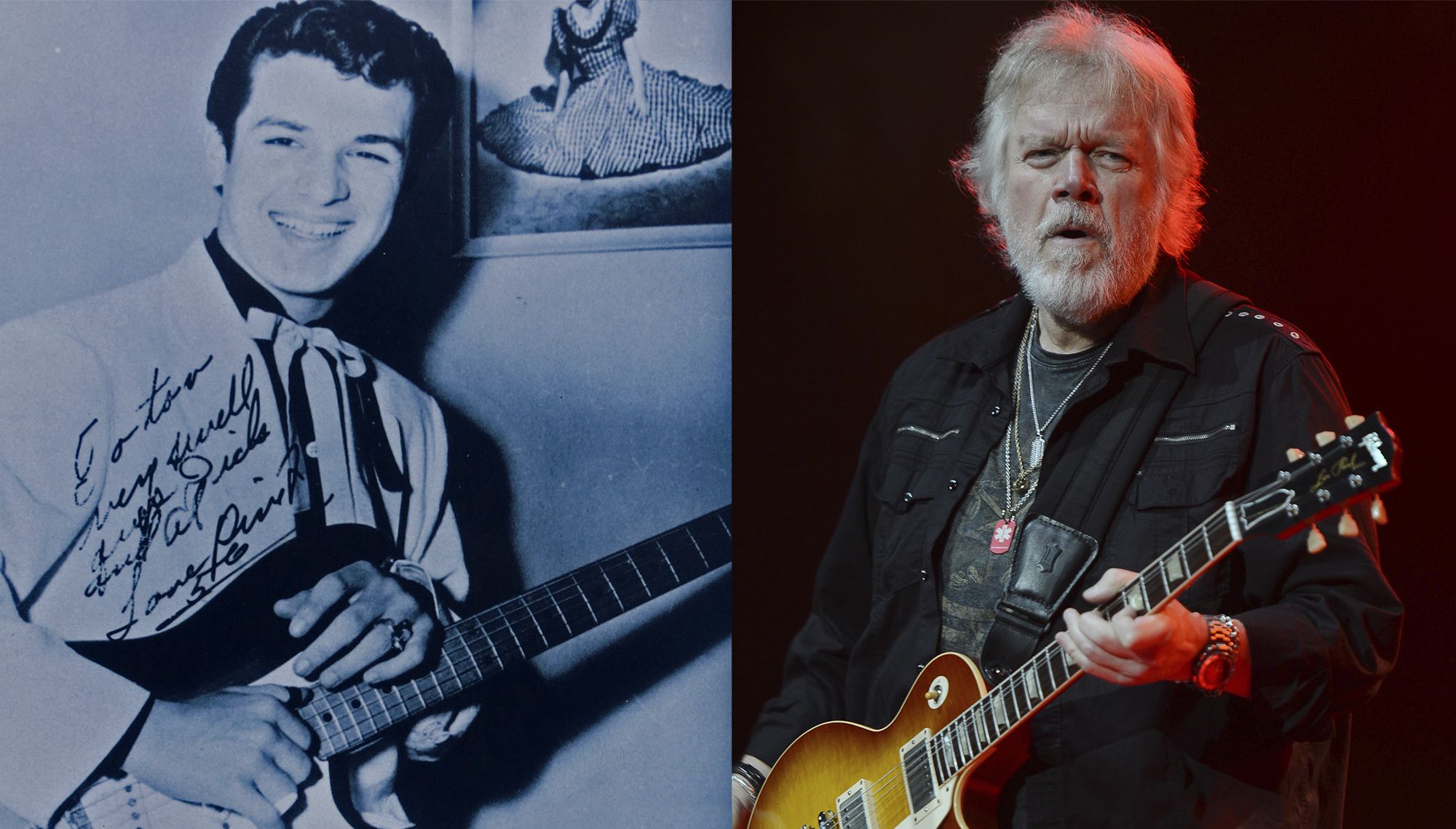
Early photographs reveal Breau, a virtuoso on both electric and acoustic guitars, often playing an orange Gretsch 6120-an instrument Bachman later sought out after exploring music stores with fellow Winnipeg musician Neil Young.
The Gift of Musical Knowledge
Bachman credits Breau with providing him a unique approach to guitar that accelerated his learning. Breau directed him to purchase Mickey Baker’s Complete Course in Jazz Guitar, a self-taught method by the renowned musician known for his work with Mickey & Sylvia.
“The book taught me that while playing a blues in G, instead of sticking to the standard G7, C7, or D7 chords, I could explore G major 7 or G major 6, or even D9 or D11. It opened my eyes to the idea that every eighth note could be a different chord, which is what I love about jazz-it allows for a fluid movement within the chords,” Bachman explains.

By the age of 17, Bachman had fully integrated this knowledge into his own musical style. “In just two years, I became the top rock and roll guitarist in town,” he asserts. “I had mastered the techniques of Merle Travis, Chet Atkins, Les Paul, Dwayne Eddy, and the Shadows, enabling me to play anything on the guitar.”
throughout their careers, bachman and Breau maintained a strong friendship. However,tragedy struck in August 1984 when Breau was found dead under mysterious circumstances. Overwhelmed with grief, Bachman pledged to honor Breau’s legacy and support his three children by releasing Breau’s recordings through a private label named Guitarchives, which launched its first CDs in 1995.
“I would compile some of Lenny’s recordings onto CDs and sell them,” he explains. “Every December, I would send a check along with a Christmas card to his children. I never took any royalties; it all whent to them,amounting to around $1,200 or $2,000 each,depending on sales.”
The Guitarchives label is currently inactive, but Bachman expresses willingness to revive it if there is sufficient interest. He has accumulated a treasure trove of unreleased recordings of Breau and related material over the years.
“I have 1,800 hours of lenny Breau recordings on CD,” he reveals. “This includes everything from private lessons to him performing his favorite song, ’My Funny Valentine,’ at various ages-12, 18, 22, and 33.”
“I could create an album titled My Funny Valentine, showcasing his evolution as a musician. Additionally, I have recordings of Lenny performing at George’s Spaghetti House in Toronto, captured on the first four-track teac that ever arrived in the city, and also performances at the Hot Potato in L.A. over several nights.”
Among the gems in his collection is a track that takes Bachman back to that unforgettable moment in the Winnipeg parking lot when Breau sounded like an entire band. “There’s a recording called ‘Pickin’ Cotten,’ featuring Lenny playing alongside Richard Cotten in Nashville. Lenny uses a seven-string guitar with the seventh string on top, while Richard plays a seven-string with the seventh string on the bottom.Together, they create a sound that feels like four musicians are playing!”