Exploring Paul McCartney’s Most Memorable bassline After The Beatles
In a revealing interview with Bass Player in 1995,Paul McCartney reflected on his most fruitful era as a bassist,pinpointing the creative peak during the making of Rubber Soul and Sgt. Pepper’s Lonely Hearts Club Band. He expressed how he could channel his full energy into crafting basslines during this time, contrasting it with what he described as his “mediocre” bass work in Wings, where he juggled multiple roles from band leader to business manager.
However, guitarist Laurence Juber, who enjoyed a brief but impactful tenure with Wings, offered a different viewpoint. In the October 2013 edition of Bass Player, he stated, “Paul composed a wealth of fantastic music and played some astounding bass with Wings that remains largely overlooked. Some of it,I believe,he doesn’t even recognize himself.”
The Underrated Masterpiece: “Silly Love Songs”
One prime example of McCartney’s brilliance is the bassline in Silly Love Songs, a track that dominated the U.S. charts for five consecutive weeks. Featured on the album Wings at the Speed of Sound, this song was recorded at Abbey Road Studios in early 1976. At the time, McCartney faced criticism from the music press and even John Lennon for producing what they deemed “lightweight” songs. In response, he crafted this track, later releasing a techno-influenced version featuring Louis Johnson on bass for the 1984 film give My regards to Broad Street.

Crafting the Sound
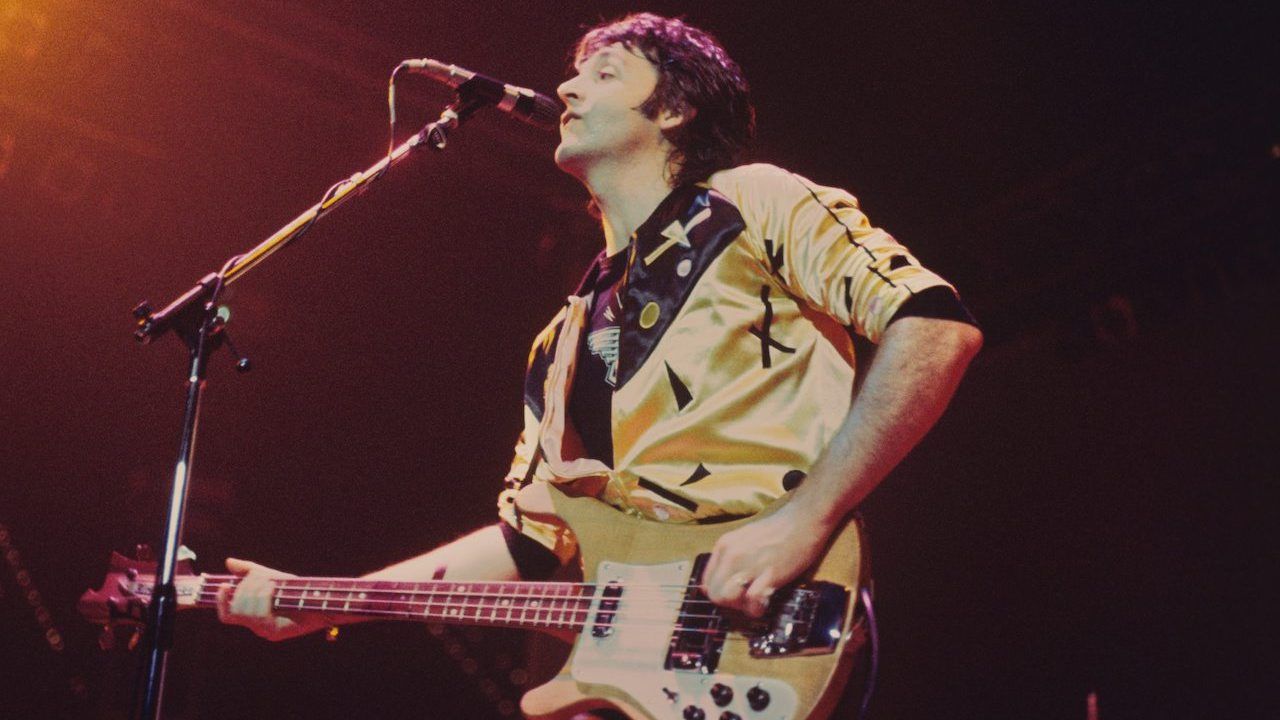
Juber, reflecting on McCartney’s studio techniques, noted that Paul utilized his flatwound-strung Rickenbacker 4001S with a heavy-gauge pick, likely recording both directly and thru a miked fender Bassman, with a Fairchild Compressor applied to all bass tracks. the rhythm section was completed by Denny Laine and Jimmy McCulloch on guitars, and drummer Joe English, with additional layers of keyboards, vocals, a four-piece horn section, and strings added later.
What distinguishes Silly Love Songs from McCartney’s earlier bass anthems, such as Come Together, where the bass intricately weaves around the vocals, or the 1979 Wings classic Goodnight Tonight, characterized by a busy bassline that complements sparse vocal lines, is the interplay of vocal and basslines in counterpoint.
Counterpoint and Melodic Flow
This counterpoint technique is a hallmark of McCartney’s style, as highlighted by Juber, who covered Silly Love Songs on solo guitar for his 2005 album, one Wing. He remarked, “Paul’s ability to sing while playing a bassline in counterpoint is extraordinary. One of my favorite bass parts of his is from his frist solo single, Another Day, where the bass and vocals occasionally move in parallel sevenths. When counterpoint is executed effectively, it can transcend customary harmony, revealing the artist’s true character.”
the song opens with eight bars that mimic an assembly line, foreshadowing the driving, repetitive bassline and four-on-the-floor drum beat that follows. The introduction hints at the bassline’s shape, which fully materializes in the first verse.
Interestingly, McCartney’s vocal phrasing spans three bars, leaving the fourth bar open for the bass. However, the bassline in bar four actually concludes a two-bar phrase that starts under the Fmaj7 chord in bar three.
Dynamic techniques
Two notable elements of McCartney’s approach are his use of chromatic passing notes, which enhance the melodic flow, and his unique application of varying note lengths. “Paul plays with a strong touch on stage, yet he demonstrates a remarkable sensitivity to dynamics and note duration in the studio. Although the fundamental sequence of C Em7 Fmaj7 recurs in both verses and choruses, the listener remains engaged because he avoids a heavy, final-sounding dominant V chord cadence.”
During the first chorus at 01:02,McCartney maintains the driving bassline while the vocals simplify to whole notes. His technique of alternating up-and-down strokes with a pick is evident in the 16th-note pickup at 01:32.
The bridge introduces a unison riff that responds to the vocal line, building momentum over the last five bars. The horn soli transitions into a breakdown at 03:12, where the vocals become increasingly contrapuntal, and the bass escalates to a root-5th-octave pattern.

The horn soli reappears at 03:42, leading into a more subdued breakdown at 04:13, where the bass momentarily recedes (listen around 04:43 for the bass panned to the left and distant). The buildup features McCartney’s Latin-inspired bass figure and a clever horn soli that lasts only four bars.
Ultimately, the song returns to a verse at 05:22, concluding on the III minor chord – “the most bittersweet chord in the C major scale,” as juber aptly noted.